Word count: 1723. Estimated reading time: 9 minutes.
- Summary:
- The final entry regarding the balcony solar installation has been written. After delays caused by smart meter outages, data analysis was completed. It is found that the solar panels contribute to bill reduction. An annual saving of €204, representing an 11% decrease in electricity costs, is estimated. The return on investment period has been calculated at 2.54 years.
Monday 15 June 2026: 17:02.
- Summary:
- The final entry regarding the balcony solar installation has been written. After delays caused by smart meter outages, data analysis was completed. It is found that the solar panels contribute to bill reduction. An annual saving of €204, representing an 11% decrease in electricity costs, is estimated. The return on investment period has been calculated at 2.54 years.
How much money is this ‘balcony solar’ installation saving me in terms of bills?
This is because the Irish ESB Networks makes public your smart meter data with a delay of a few days, but not infrequently they have outages which delays that data by weeks. We unfortunately had one of those outages end of May, and I didn’t get complete smart meter data for analysis until today.
Quick recap
You will remember from the first post that current electricity costs and tariff distribution are as follows:
| Period | Current cost per kWh | Summer daily avrg | Winter daily avrg |
|---|---|---|---|
| Peak rate: 5pm - 7pm | €0.38 (+65% over night rate) | 1.93 kWh (€0.73) | 2.41 kWh (€0.92) |
| Day rate: 8am - 5pm, 7pm - 11pm | €0.33 (+43% over night rate) | 8.81 kWh (€2.91) | 9.80 kWh (€3.23) |
| Night rate: 11pm - 8am | €0.23 | 3.15 kWh (€0.72) | 3.30 kWh (€0.76) |
And that:
- 66.7% of the bill goes on day rate electricity.
- 16.7% of the bill goes on peak rate electricity.
- 16.5% of the bill goes on night rate electricity.
So, from a bills perspective, you only really care about day rate and peak rate electricity as that is 83.5% of your electricity bill.
Furthermore, that two solar panels were first hooked into the house mains from around mid-April, with those being initially ground mounted and left to run for a few weeks while I debugged the setup and made sure it would all work before going to the bother of installing them onto the outhouse roof. From the 8th May onwards I had all four panels mounted onto the outhouse roof and contributing power. The configuration is that three panels are connected to the battery storage and one panel is connected to the inverter on its second input – from 9.30am each morning the battery charges to full and a single panel supplements household electricity usage; once the battery is charged, all four panels supplement the household usage; from 5pm onwards the battery discharges at 220 watts with the single panel supplementing, until 11pm when everything turns off until 8am in the morning when the battery again outputs 220 watts with the single panel supplementing. One should therefore save at least two kWh of day and peak rate electricity per day in the summer months, and I had been expecting a theoretical saving of around twenty percent of day + peak rate electricity usage during those summer months. That, based on the 83.5% of my electricity bill above, should reduce my bill by 16.7%, or about €25 per month, but again only during the summer months where there is enough free energy falling from the sky to fully charge the 1.6 kWh battery storage each day.
The last two years at the mains meter box
Note that the Irish ESB only provide the last two years of detailed data from your smart meter:
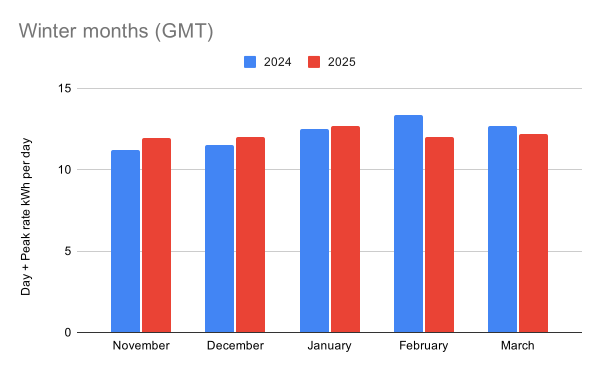
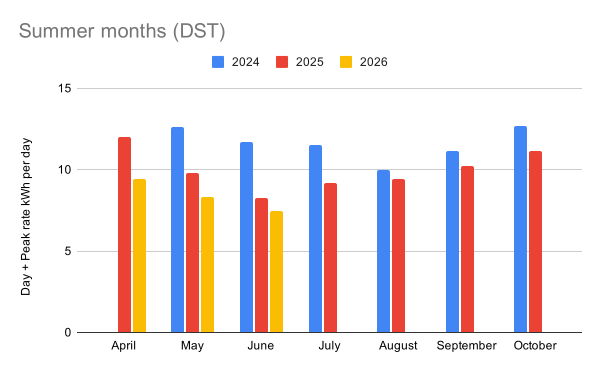
I’ve separated daylight savings time (DST) months from winter months (GMT) because the seven months of DST are the only ones from which you’ll get much off solar panels, and even then March has been considerably better than October for solar radiation in the past two years. DST also matters because you switch on lights earlier and later in the day, so you tend to use more power during GMT months. Which leads me into …
Confounding factors
The most natural thing to do would be to compare last year’s electricity consumption to this year’s, however last year before June I had the main developer workstation turned on daily, and this year past I mostly don’t have it turned on daily as my Macbook is enough for most of the things I need to do if I’m not earning money (e.g. right now, I’m writing this on the laptop plugged into the developer workstation’s large 4k monitor, because spinning up the dev workstation to type text is way overkill). In 2024, an average typical summer day + peak rate used 11.62 kWh and an average typical winter day used 12.25 kWh, whereas after unemployment an average typical summer day + peak rate used 9.67 kWh (-16.82%) and an average typical winter day used 12.18 kWh (-0.6%).
I must admit a little surprise that I had the developer workstation turned on so frequently during the most recent winter months, but that does match my memory – I remember being quite grateful, as I am every year, for the free space heating my office gets from the developer workstation being turned on. The fact that this adds more than one eighth to my total household electricity bill is a little sobering, but at least heat generated by the workstation is a more productive use of that electricity than an electric bar heater.
I should also mention that immediately after my employment ended, I particularly was not at home as I was out riding bikes and climbing mountains during June and July 2025, so the electricity for those months was lower than it likely will be this year where I’m more accustomed to having my freedom, for example.
What is the estimated reduction of my electricity bill?
Obviously the yellow bars in the summer months chart above for April, May and June 2026 are our reductions from the ‘balcony solar’. After adjustment for my unemployment reducing power consumption anyway, I reckon that the solar panels contributed a reduction in peak and day rate electricity consumption according to the ESB meter box as follows:
| Month | Reduction |
|---|---|
| June 2026 | -22.96% |
| May 2026 | -13.89% |
| April 2026 | -2.54% |
May is probably lower than it should be because my APSystems EZ1 inverter’s MPTT1 input died, so I had to route everything through its MPTT2 input only. That reduced efficiency by a bit – judging by June’s results so far, by quite a bit in fact. In June a replacement was installed and the original sent back as RMA, so we’ll see how things go in the next few months.
Assuming that you will only get much from the panels for seven months, and that winter months use more power, I reckon I might get an annual electricity bill reduction of around eleven percent. That is, in my case and with current electricity prices, equal to €204 saved in bills per year. That is a return on investment period of 2.54 years, a bit longer than I had originally intended (a year!).
Why so low? This 2023-era low voltage system is particularly inefficient, I reckon it loses a good 20-25% of the power it captures, plus it doesn’t charge optimally, nor does it discharge optimally. A 2025-era or later system based on dual inverters so it is capable of simultaneous charge and discharge would be considerably less stupid with power distribution, and it would respond to changes in household consumption rapidly, rather than wastefully sitting at a constant discharge rate between fixed time periods irrespective of the weather outside.
As covered in previous posts in this series, for a little more money you can get FAR better kit, modern stuff instead of this 2023-era kit that I ended up with thanks to Aliexpress sending me not what I had thought I had ordered. As we’ll probably be out of this rented house within 2.5 years – well, hopefully! – I’m going to lose money on this project. But for anybody reading, if you expect to still be living where you are right now for more than two years, you really ought to be very strongly considering installing micro solar generation into your house. Even in Ireland’s typically overcast skies! Solar battery storage has gotten so cheap it’s a no brainer.
This is despite zero subsidies from the government (indeed, a 23% VAT tax on all the equipment!), and zero payment for excess power contributed to the grid. Even with those very unfavourable conditions, microgeneration solar is face palm obviously the right move with a two year payback period, as year three onwards is pure gravy.
What’s next?
The popups installation for my site has begun! I’ve been waking at 4am to be onsite for 6.30am this week to help out, as I will be tomorrow morning. Thank God I am unemployed! And expect an entry on here with pictures when it’s all done.
I asked the Step 3.7 Flash LLM how it would improve this website. It gave a long list of modern web page design ideas, none of which interested me, bar one: a dark-light theme which auto switches based on your viewing device’s dark-light theme setting (apparently this landed with CSS v5, I don’t pay attention to new web standards until somebody – or some LLM – points stuff out to me). So I went ahead and implemented that dark-light theme for this website, and you can expect an entry on that soon.
My ‘end of an era’ special on Chinese direct to consumer sales platforms like Aliexpress is probably after the dark-light theme entry, though an entry on the site popups installation might beat it. In any case, I hope to get that end of an era entry up before the end of the month when the EU tariff comes in as then would be timely.
Other than those three, I don’t have any particular plans for diary entries here. School for the kids ends tomorrow week, after which I’ll be on childcare until end of August, and I’ve been tempering my expectations about getting anything else done appropriately. I expect plenty of bicycling around North Cork’s spectacular scenery on the e-Bikes as with last year, but also upcycling furniture (the kids will be learning how) and painting walls (the kids will also be learning how). I’m sure between all that the summer will fly and before we know it they’ll be back to school.
Who knows if my builder will turn up and erect my house by then! I suspect it very unlikely, but we’ll find out.
| Go to previous entry | Go to next entry | Go back to the archive index | Go back to the latest entries |