Word count: 7284. Estimated reading time: 35 minutes.
- Summary:
- A DIY balcony solar installation in Ireland is described. High electricity costs are discussed, and the ROI of the system is calculated. Technical details regarding inverters (Anker Solix, APSystems EZ1-M) and battery storage are provided. The importance of simultaneous charge/discharge capability is stressed, as maximum efficiency must be achieved for significant savings.
Saturday 16 May 2026: 22:54.
- Summary:
- A DIY balcony solar installation in Ireland is described. High electricity costs are discussed, and the ROI of the system is calculated. Technical details regarding inverters (Anker Solix, APSystems EZ1-M) and battery storage are provided. The importance of simultaneous charge/discharge capability is stressed, as maximum efficiency must be achieved for significant savings.

You can see where the join in the subframe was detaching from rust
Thankfully all that is now fixed, and many thanks to my brother-in-law Donal for all his help.
Last diary entry I mentioned that I was doing manual labour most days installing into my rented house temporarily four solar panels from my future house. I have a box of solar panels just sitting there, along with their wall mounting brackets, so it made no sense that they shouldn’t be reducing my bills, especially as I have had no income for the past eleven months now.
As electricity prices climb ever steeper in Europe with little chance of getting better in the next few years, there will surely be a much larger push to install solar panels than until now. Traditionally, solar panel installations in Ireland cost many thousands of euro: about €7,500 for the average installation in 2026. And that is after:
- 0% VAT incentive.
- SEAI grant worth a further 19%.
- Long, long wait times due to all the grant approved installers being booked out.
Thankfully, there is another way which is very popular in other EU countries: balcony solar, which is 100% DIY installation and therefore vastly cheaper.
As it’ll be so long, this topic will span three diary entries:
- The hardware and the theory (this post!).
- Scripting and controlling the overall system (next post).
- The empirically measured reality (post after that).
Table of Contents
Balcony solar
In 2019, the German parliament removed the requirement for micro solar installations to be installed by expensive professionals, enabling the home owner to DIY their own installation. There were sensible conditions placed on these micro installations:
Nothing in the installation could use more than 60 volts in order to comply with existing electrical safety legislation (you don’t need a registered electrician when DIY wiring with voltages below about 80 volts).
The inverter must feed the power into the house mains using a standard electrical socket, thus making the inverter like a household appliance.
The maximum feed in is capped to 600 watts (later increased to 800 watts in 2024).
The inverter must cut all output within a few seconds of the mains grid disappearing to prevent workers getting electrocuted – also, because these reverse feed up a standard household plug, a home owner could touch the pins of the plug after unplugging it.
The idea was that apartment dwellers – which are the majority in Germany – could fit two to four panels on their balconies and capture electricity when the sun hits their balconies – which if their household didn’t use the power it would be exported to the grid for others to use, which then appeared as a credit on their electricity bill.
Unsurprisingly, balcony solar proved to be very popular. The first models went on sale in 2020; by the end of 2023 over half a million systems had been installed, and by the end of 2025 over two million systems had been installed. As there was now an established market for these products, prices kept tumbling and multiple countries around the world enacted specific laws enabling them.
Ireland is one of an increasingly few European countries with no plans to introduce specific legislation for balcony solar. In Ireland, you cannot export to the grid without being granted approval first, and for that you need a RECI qualified electrician to submit the application. So, in Ireland, we can never feed in more power than the house consumes.
That implies that we have no choice but to fit battery storage, but thankfully due to grid export prices in Germany tumbling there has been a large increase in the production and popularity of battery storage for balcony inverters, so now it’s very feasible to fit a small amount of battery storage and for that to still be worth doing given we hopefully only have a year or two left in this rented accommodation. To be specific, why the cost benefit for installing these systems changed a few months ago:
The energy shock from America blowing stuff up where a fifth of the energy comes from pushed up demand for balcony solar enormously.
That increased competition, but also economies of scale, and prices for these systems fell still further.
The cost of electricity rose, which made the Return on Investment (ROI) for balcony solar much shorter than before.
Return on investment periods for balcony solar installations in Ireland are now below two years with current electricity and component prices – and that’s without any subsidies whatsoever! Anybody not fitting them is being foolish at that rate of return.
How much energy does our rented house use?
Everybody in Ireland – irrespective of their current electricity provider – can pull the last two years of their electricity usage from https://www.esbnetworks.ie/services/manage-my-meter/view-my-smart-meter-usage with a thirty minute granularity. The website will export a CSV, and from that I can tell you that assuming this month’s current electricity prices which will surely rise still further in the months to come:
| Period | Current cost per kWh | Summer daily avrg | Winter daily avrg |
|---|---|---|---|
| Peak rate: 5pm - 7pm | €0.38 (+65% over night rate) | 1.93 kWh (€0.73) | 2.41 kWh (€0.92) |
| Day rate: 8am - 5pm, 7pm - 11pm | €0.33 (+43% over night rate) | 8.81 kWh (€2.91) | 9.80 kWh (€3.23) |
| Night rate: 11pm - 8am | €0.23 | 3.15 kWh (€0.72) | 3.30 kWh (€0.76) |
Total average cost per day is therefore €4.36 for 13.89 kWh in summer and €4.91 for 15.51 kWh in winter, for a total annual bill of €1,675 per year which is for 5,314 kWh of electricity. The key part to take away from this is:
- 66.7% of the bill goes on day rate electricity.
- 16.7% of the bill goes on peak rate electricity.
- 16.5% of the bill goes on night rate electricity.
Therefore, anything we can do to get (i) day rate electricity and (ii) peak rate electricity consumption down will have the largest impact on my bill. Night rate electricity can be safely ignored for a micro solar installation.
Breaking it out into thirty minute granularity:
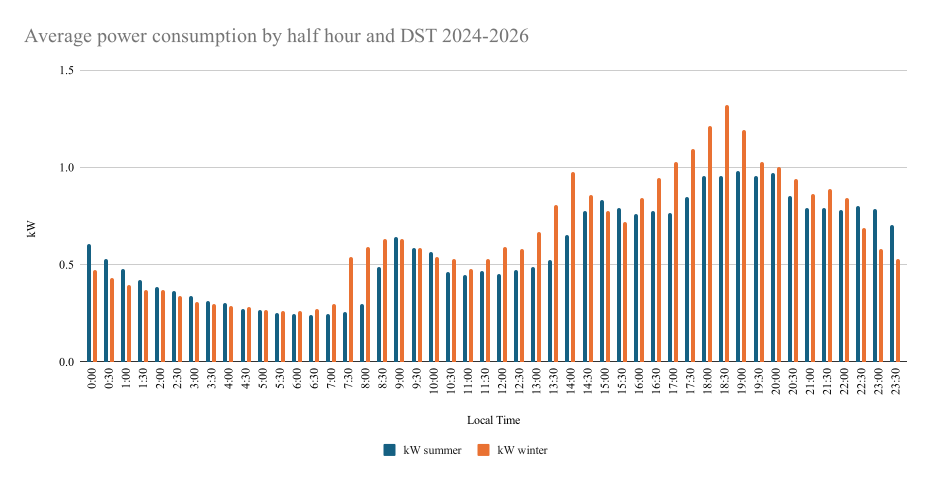
Straight away it is obvious that the bulk of the electricity bill occurs between 3pm (when the kids get home) until 11pm (when we all go to bed). There is a small spike in the morning as everybody gets hustled out to school and jobs, but generally speaking the hours you care most about are when the sun is out and the first five hours after the sun goes down.
Indeed, if for at least the sunny months we could cover 70% of the day and peak rate costs with solar – that’s seven months – one third of my annual bill would get taken off. So that put an upper bound on the cost of this installation of €544 inc VAT. If I could assemble a system for less than that, I’d have Return on Investment under one year and therefore it would be rational to install said system, even though we’ll hopefully be moving out from this rented house in the next year or two.
Parts I already had
I already had the solar panels and their mounting brackets, plus some free pressure treated wood so all the external stuff I could get for free. Therefore all that cost me zero, and I didn’t count it for my personal ROI calculations.
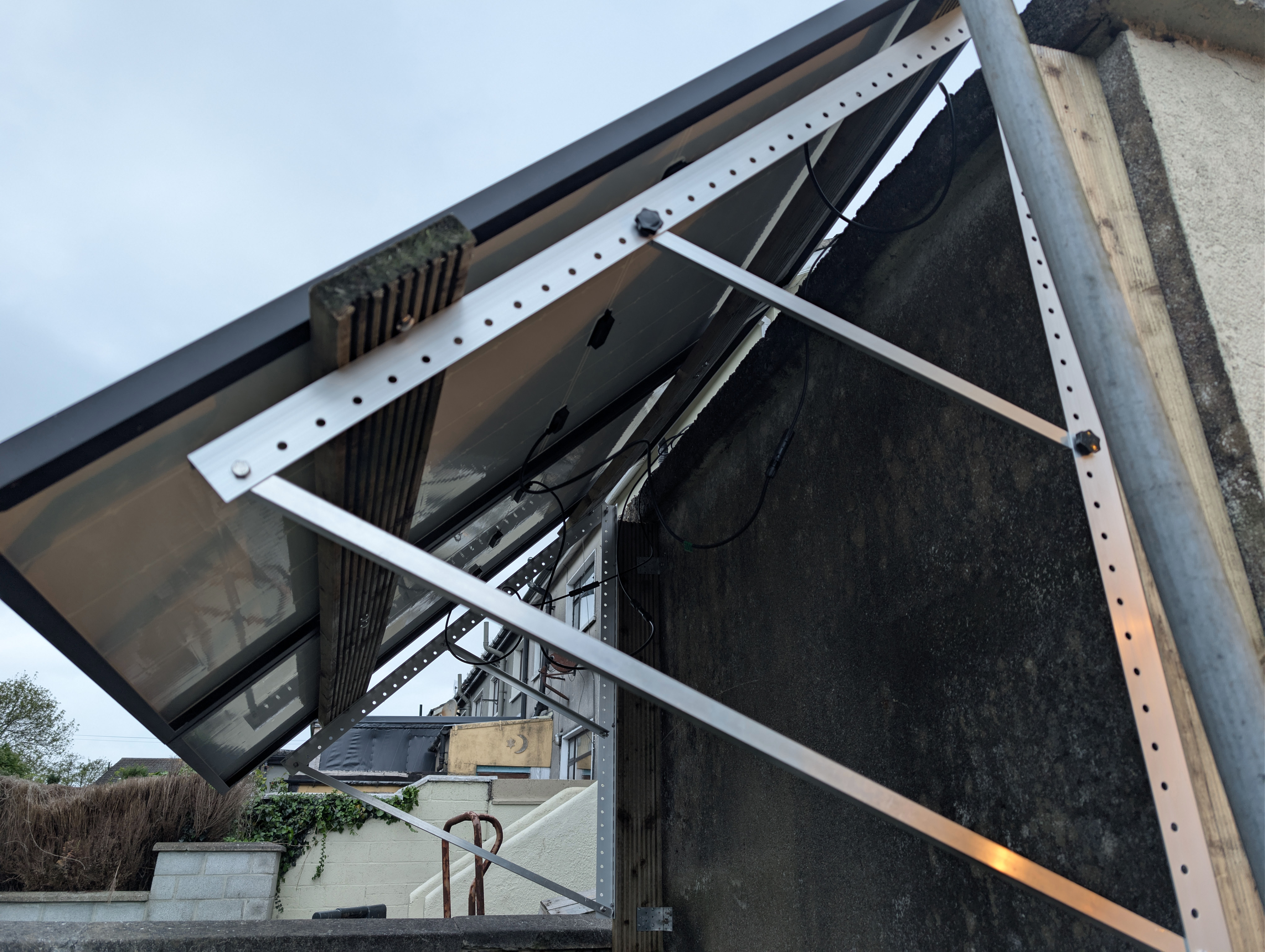
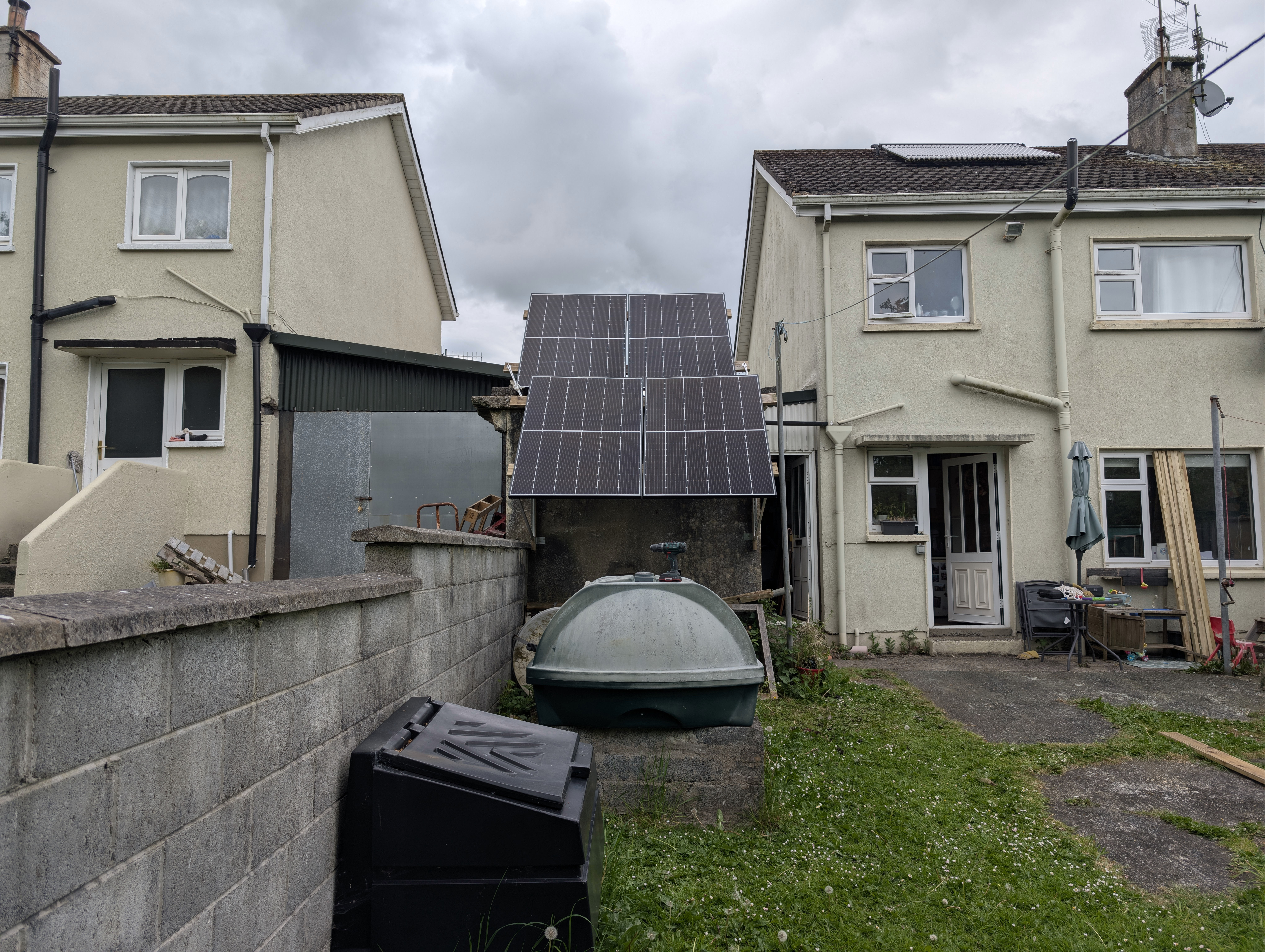
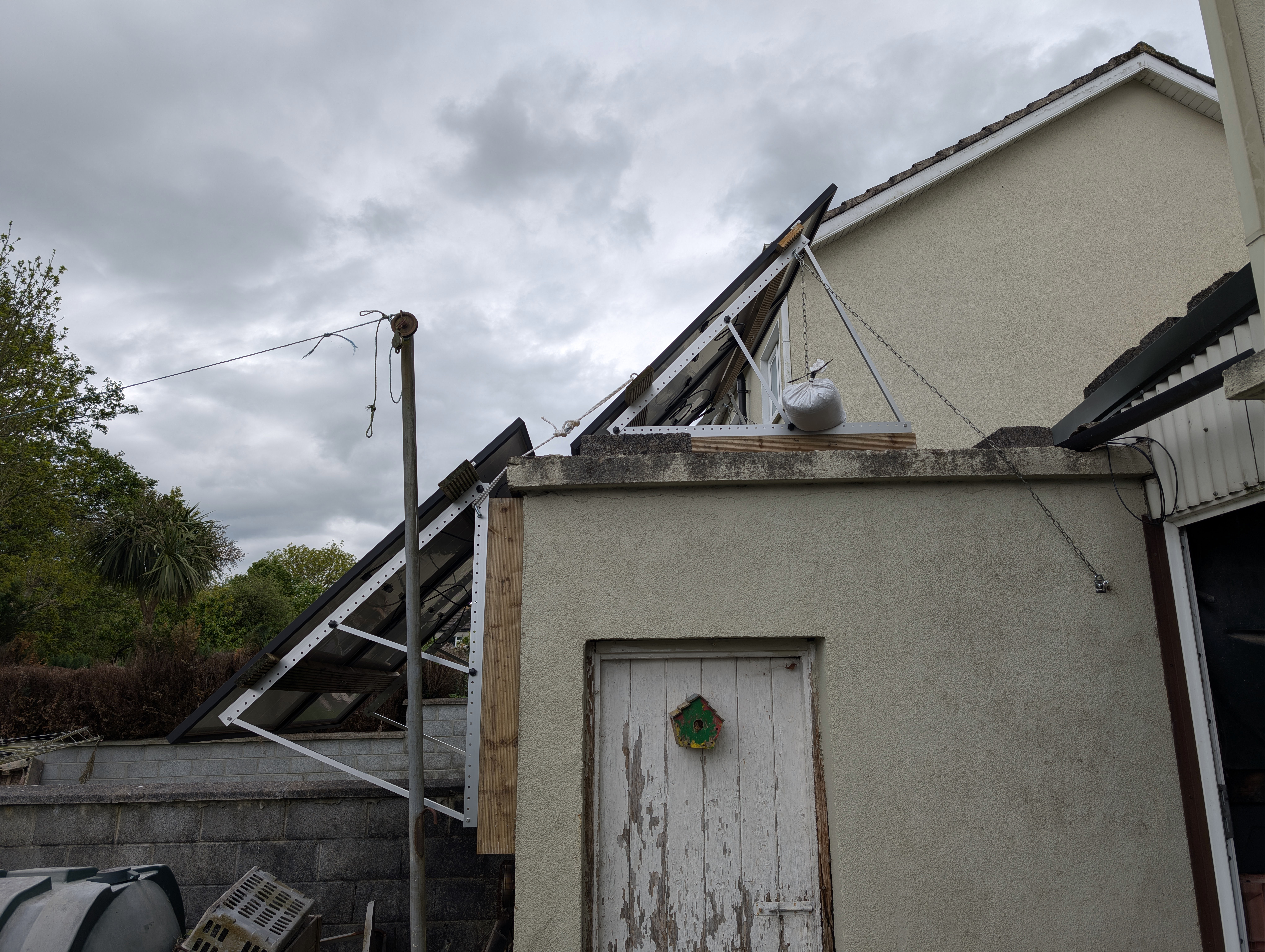
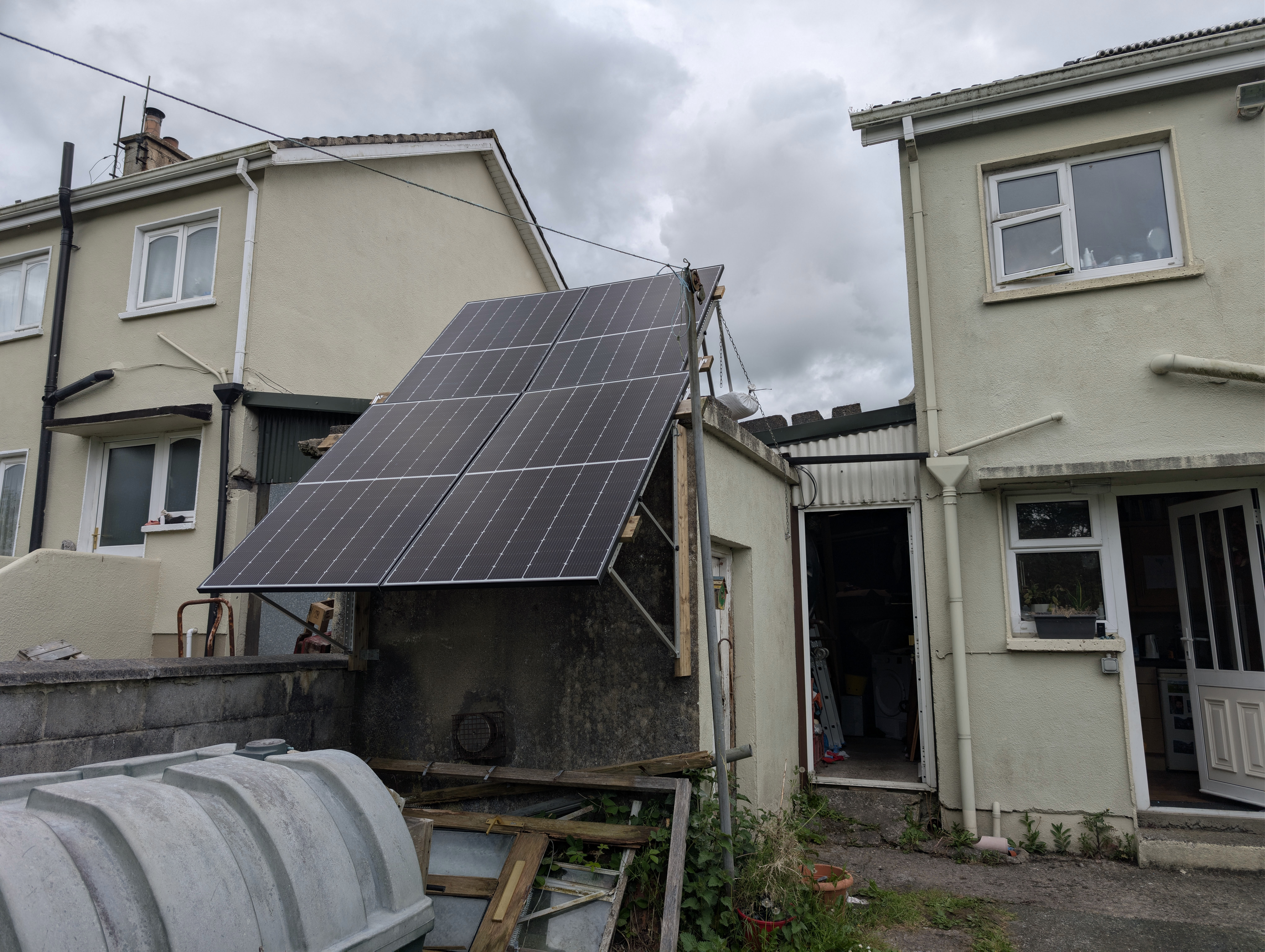
Though, let’s cost those out here now for anybody else interested:
- 4x ~450w solar panels: €200 (used off donedeal, new currently cost about €70 each way up from last year when new cost €40)
- 4x aluminium solar panel brackets from Amazon: €63
- Pressure treated wood: €20
- 2x Y-splitters and solar cables: €30
Total: €353 inc VAT and delivery (excluding the panels delivery).
(Delivery for panels is a real pain as they’re so bulky, if you have an estate car or a van or can borrow one, then collecting them will be almost always cheapest)
You might wonder why wall installation and not roof installation? Of course the roof will produce superior results. But it’s also a lot more hassle having to pull up roof tiles, get brackets and rails in there, then get the panels up there without the wind blowing you off the roof etc. Wall mounting is drilling in a few concrete anchors, attaching the brackets, get the panels on and you’re done. Much less hassle.
Modern solar panels are surprisingly okay with not pointing directly at the sun. Your ideal angle for Ireland is about 45 degrees, which makes calculating the brackets dead easy. You point them as south as you can manage. Our rented house actually points 29 degrees east of due south, so those panels above point about an hour too early in the day for maximum yield. It’s still something like 86% of peak at midday, and because Ireland doesn’t get much direct sun the typical overcast clouds do a great job of mushing the sunlight all around so direction matters far less in overcast Ireland than sunny places elsewhere.
As I often say to people who think their site unsuitable for solar: just fit more panels. At fifty euro each, almost always just throw more panels at every problem, and you get less directional sensitivity for free if you fit 3x more to handle overcast weather.
Best bang for the buck balcony inverters + battery storage
As I had alluded to earlier, because we’re so limited in maximum feed in, we will have no choice but to fit battery storage so that the excess from the panels goes into the battery when it’s sunny, and then that battery discharges when it’s not sunny, and always staying under whatever the house is consuming from the mains.
Only very recently have balcony inverters with storage come under €750, even a year ago they were all well over a grand. Most quality branded balcony inverters without storage now cost less than €120 delivered from your local Amazon – if you’re willing to take unbranded, Aliexpress will deliver one for about €70. If you shop around, the cheapest inverters with storage built in cost €650-700 including 23% VAT and delivery to Ireland, and you have a choice of:
- Marstek Venus A which has a 2.12 kWh battery, 4 MPPT inputs up to 2.4 kW of panels, and it can supply up to 1.5 kW to AC. It can charge from the grid using cheap night rate power as well as from panels.
- Anker Solix Solarbank 2 E1600 Pro which has a 1.6 kWh battery, 4 MPPT inputs up to 1.8 kW of panels, and it can supply up to 800 watts to AC.
Everything else exceeds €750 once including Irish VAT @ 23% (which German vendors have to charge, instead of the 0% they charge German addresses) and delivery to Ireland. And both cost more than my €544 limit!
The Marstek is the superior technical specification for the money, but if you search online there are more reports of flakiness and unreliability issues than for the Anker. The Anker is the same brand we all know for making power adapters and battery banks for years, so they’re a better known brand plus because they’ve sold hundreds of thousands of these boxes, their Home Assistant integration and open source tooling is much more mature.
Just before I departed for England end of March I spotted online an Anker Solix Solarbank 2 Pro for €450 delivered to Ireland. With an Aliexpress coupon, I got that down to €409. It seemed a bit too good to be true, but I reckoned why not take the punt, usually when they realise my Irish address the vendor tends to cancel the order, and then I get my money back. 85% of the time I get my money back instead of the item I ordered, the other 15% of the time I get really good bargains.
What actually turned up
Much to my surprise while I was in England the order went to dispatched, and about ten days later after I had returned it arrived on my doorstep. I eagerly tore it open to find … it wasn’t an Anker Solix Solarbank 2 E1600 Pro, but rather an ‘Anker Solix Solarbank E1600 2’ with a model code of A17C03A2 i.e. gen two of model A17C0.
You can obtain this for about €442 inc VAT delivered to Ireland, so I had gotten quite a good deal. However, there are good reasons why you do NOT want to buy this model as your balcony solar solution – for one thing, it lacks entirely an AC inverter. What it’s intended for is that it adapts your current battery-free balcony inverter into a battery storage one by sitting in between your panels and your existing inverter, so basically it’s an upgrade kit for an existing system.
The gen one of this model I had read much about. It is considered one of the most frustrating balcony solar products of the past three years (the gen one launched in 2023). This was, however, the gen 2 and the main changes over gen 1 are:
- It has an integrated zero watt output switch, which was previously a €50 separate add on for the gen 1. This means it can exclusively charge the battery without sending anything to the output, which maximises the battery charge rate.
- It has added heating for the batteries so they can be used in winter (at a cost of energy efficiency obviously), where ‘winter’ is defined as the batteries being below 20 degrees celsius (yes you did read that right).
I initially opened a return case as this wasn’t the model I ordered. However Aliexpress wanted a video of me opening it, and in my excitement I hadn’t taken one. Fool on me. However I had also noticed that I could pick up a standalone balcony solar inverter for about €109 delivered, so that brought this total system to €518 inc VAT inc delivery to Ireland. Which is under my ROI threshold of €544, so I decided to try keeping it and I closed the RMA ticket.
The Anker Solix Solarbank E1600 gen 2 (A17C03A2 not A17C03A1)
This system, which is intended for upgrading an existing balcony solar installation, has two sets of inputs where the solar panels connect (BUT both inputs are wired into a single MPPT input, which they don’t make entirely clear except in some small writing buried in the user manual) and one output which connects to the balcony inverter. The idea is that power in excess of what the inverter consumes is directed into the battery storage, and then the battery is later used to power the inverter when the sun has set.
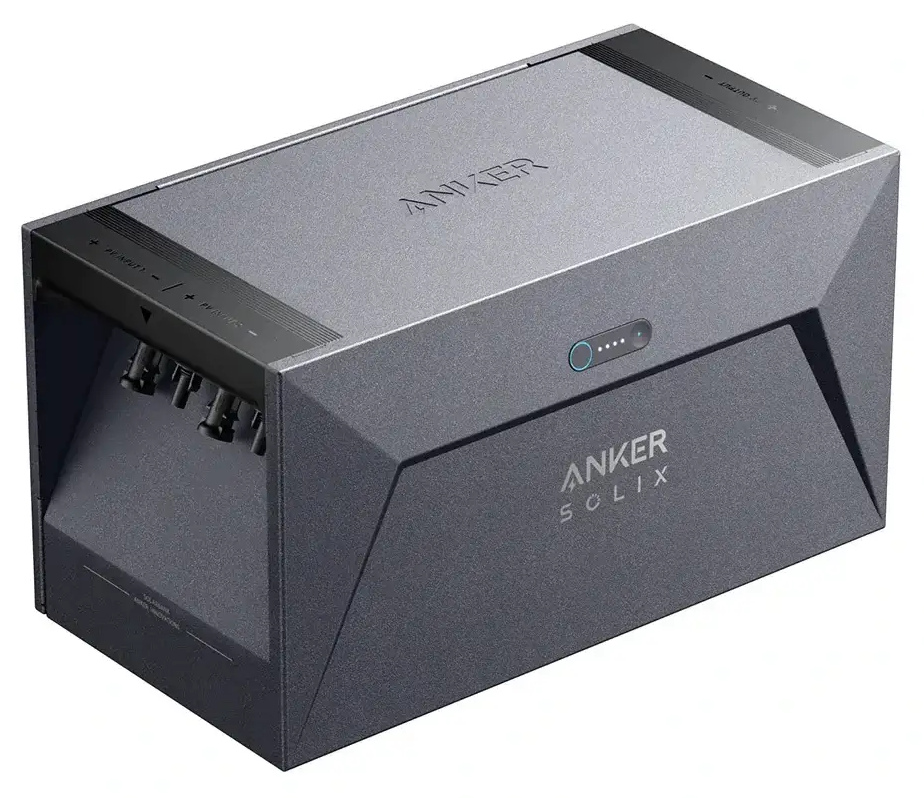
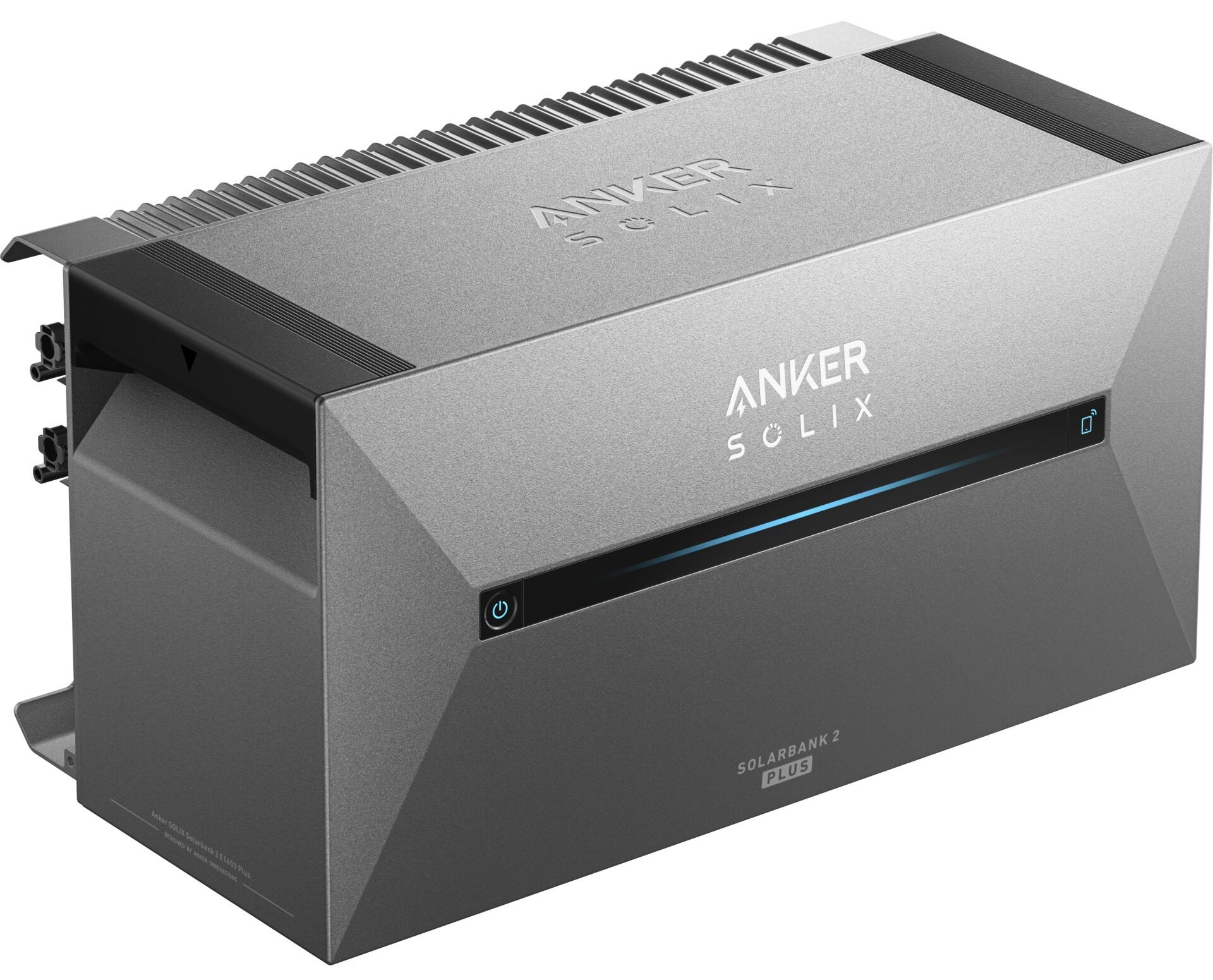
It has the same 1.6 kWh battery as the Anker Solix Solarbank 2 E1600 Pro and the Anker Solix Solarbank 2 E1600 Plus, and specifications wise looks like the Plus model but minus a built in AC inverter, though in fact this model has much cheaper electronics and quite a bit worse design tradeoffs. They also look physically dissimilar, here are pictures of the E1600 non-Plus, and E1600 Plus:
The Anker Solix Solarbank E1600 gen 2 can take a maximum of 30 amps of input at a voltage range between 30 volts and 55 volts, and can output up to 30 amps from its single output port. Claimed MPPT efficiency is 97.8%, and the reversible boost-buck converter is 93% so power drawn from the battery loses about 9%. My panels have an open circuit voltage of 41 volts, so you must NOT connect panels in series like you’d normally do, but rather in parallel. Each of my panels theoretically could output ten amps, but in realistic conditions it’s going to be more like eight amps. As I mentioned earlier, it only has a single MPPT input despite having two physical inputs, so however you prefer to wire your panels in parallel across those two physical inputs is up to you, as they’re electrically identical. This is why I listed Y-splitters for the solar panel cables above.
Its battery can charge at up to 800 watts, which I’ve personally confirmed is true. Supposedly it can also discharge at 800 watts, but you’ll need your inverter to play ball which we’ll get onto later.
One very big caveat with this model is that it only has a single reversible DC-DC converter i.e. it can either (i) charge the battery from solar OR (ii) discharge the battery (or enter bypass mode, where solar input is directly passed to output). The Plus and Pro models have TWO converters, and so what is going on with charging doesn’t affect discharging, and therefore if a cloud passes overhead then the battery can be drawn down upon to maintain the AC output level. This model can NOT do that, it is EITHER charging or discharging, though you can set a schedule to force it to charge or discharge throughout each day. Obviously the lack of two converters makes this box less efficient, but in the end you get what you pay for.
Unfortunately, the Anker documentation doesn’t explain any of the above well and makes it seem like their battery box can both charge and supply the house simultaneously. This is ‘true’ in a way: this model appears to have maybe four fixed shunt ratios between input/battery/output, so as an example it can:
- Charge battery 100%, output 0%
- Charge battery 3x output, so if input were 1000w and output were 100w then the battery gets charged at 300w, and 600w is wasted. Yes, you read that right!
- Charge battery at same as output, so if input were 1000w and output were 400w then the battery gets charged at 400w and 200w is wasted.
- Charge battery 0.33x output, if input were 1000w and output were 600w then the battery gets charged at 200w and 200w is wasted.
I chose the 3.0 - 1.0 - 0.33 ratios as approximately correct. There may be a few more fixed shunt ratios in hardware, though not many more. What you should take away from this is: if your house is drawing a small amount of power under the fixed shunt ratio mode it can greatly reduce your battery charge rate, IF the Anker Solarbank has chosen a ratio which clamps battery charge rate.
If you’re about to ask how often its firmware chooses a ratio which clamps battery charge rate and wastes solar input?, the answer is ‘most of the time’. The firmware is profoundly stupid and delegates all decision making to the Anker cloud (and if you configure the device without a cloud connection, then it delegates everything to the app running on your phone over Bluetooth, and if your phone loses the Bluetooth connection then the device does not implement the schedule you told it in the app. Oh, and yes, in Bluetooth only mode the Anker app must always be running in the background, and it’ll zomp your phone’s battery life as a result).
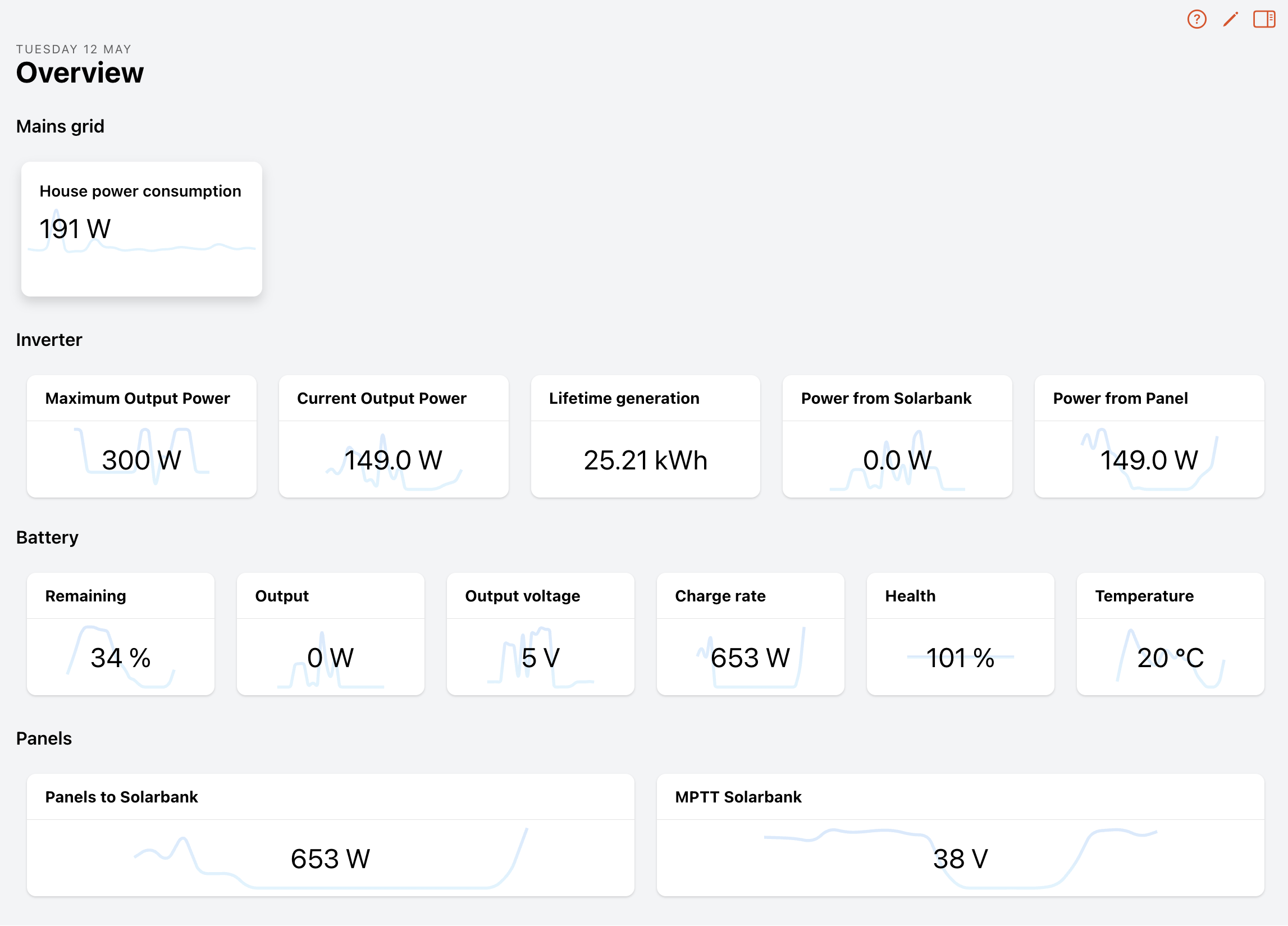
Unfortunately, the Anker cloud’s decision making appears to me and everybody who has complained about it online to be profoundly dumb. The only good news here is that the open source ecosystem support for interacting with the Anker cloud is very mature, and I was able to cobble together an Anker cloud to MQTT bridge docker image in only a few hours of work (and without AI assistance too). Once into MQTT, I could hook it into OpenHAB and within that I can easily script command and control of the battery and the inverter, plus a dashboard:
(I should mention for completeness that there are also mature open source ecosystem solutions for controlling the device entirely over Bluetooth e.g. https://github.com/flip-dots/SolixBLE. In my case, I’d need a Bluetooth repeater to reach where the device is stored in the garage, and it was just cheaper and easier to use the Anker cloud interface instead. If I were expecting to live in this rented house for more years than I currently expect, I’d probably invest in a €30 Zigbee/Bluetooth repeater off Aliexpress and exclusively drive the Anker device from OpenHAB over Bluetooth only)
Thanks to the hundred thousand odd users of this system out there, there has been work to deduce what rules Anker programmed into the firmware. Almost all of that is written in German, but thanks to AI that isn’t a problem nowadays. Here are the approximate rules, executed in order, if the battery is not full and your Anker app schedule has enabled battery charging:
- If solar panel input is less than 15-20w, sleep and emit no output.
- If solar panel input is less than 45-50w, charge the battery and emit no output.
- If solar panel input is less than 100w, if output is enabled, don’t charge the battery and emit output.
- Otherwise, choose a fixed shunt ratio from those available such that the output gets something like the configured amount (e.g. if you configured 100w, you might get 100-250w; if you configured 200w, you might get 100-300w), with the balance charging the battery. Reevaluate and adjust the ratio chosen periodically. Note that output can NOT be below 100w if the battery is charging unless output is set to 0%.
- BUT if battery is being charged at maximum rate, choose a fixed shunt ratio so that output gets the balance of the solar panel input. This happens even if you set the output to 0%. Yeah I know, go figure.
In other words, the firmware is bound by minimums: if solar input is high and you’ve told it to exclusively charge, it’ll use as much power as possible to charge and dump the rest to output; if you’ve told it to output say 200w, it’ll get somewhere within 50-150% of that even if it curtails battery charging rate. It’s a dumb design if it weren’t for the cost element – as converters get ever cheaper, almost certainly in the future just fit two converters and call it a day. Back when Anker designed this maybe in 2021, converters were expensive so they made a compromised design in order to use exactly one converter. The fixed shunt ratio design is kinda clever for cost reduction, but it’s also very square hole round peg.
For temperature:
- If battery temperature is below 20 C, activate 80w battery heater until battery temperature is at least 20 C. Yes this wastes a lot of solar gain.
- Charge up to 600w if battery temperature is less than 24 C. Note that charging at 600w will heat the battery up over 24 C within minutes unless it’s very cold outside.
- If battery temperature is over 24 C, charge up to 800w.
The reason this coddling of the battery is done is because (i) it’s a 16v battery so to get the amps to move you can’t be cold and (ii) they guarantee 80% capacity remaining after 6000 cycles. Most LiFePO4 batteries are charge-discharged through a voltage range which results in a ~2000 cycle lifetime, but you can narrow both that voltage range and the temperature range and the amperage pushed through the battery to reach 6000 cycles.
Given the cold Irish climate, the battery heater characteristic suggests that fitting an insulation blanket to the Anker Solarbank is a very wise idea as it will reduce energy losses to the battery heater. I fitted a roll of 10 mm ceramic fibre blanket out of an overabundance of caution in case the battery ever caught fire:
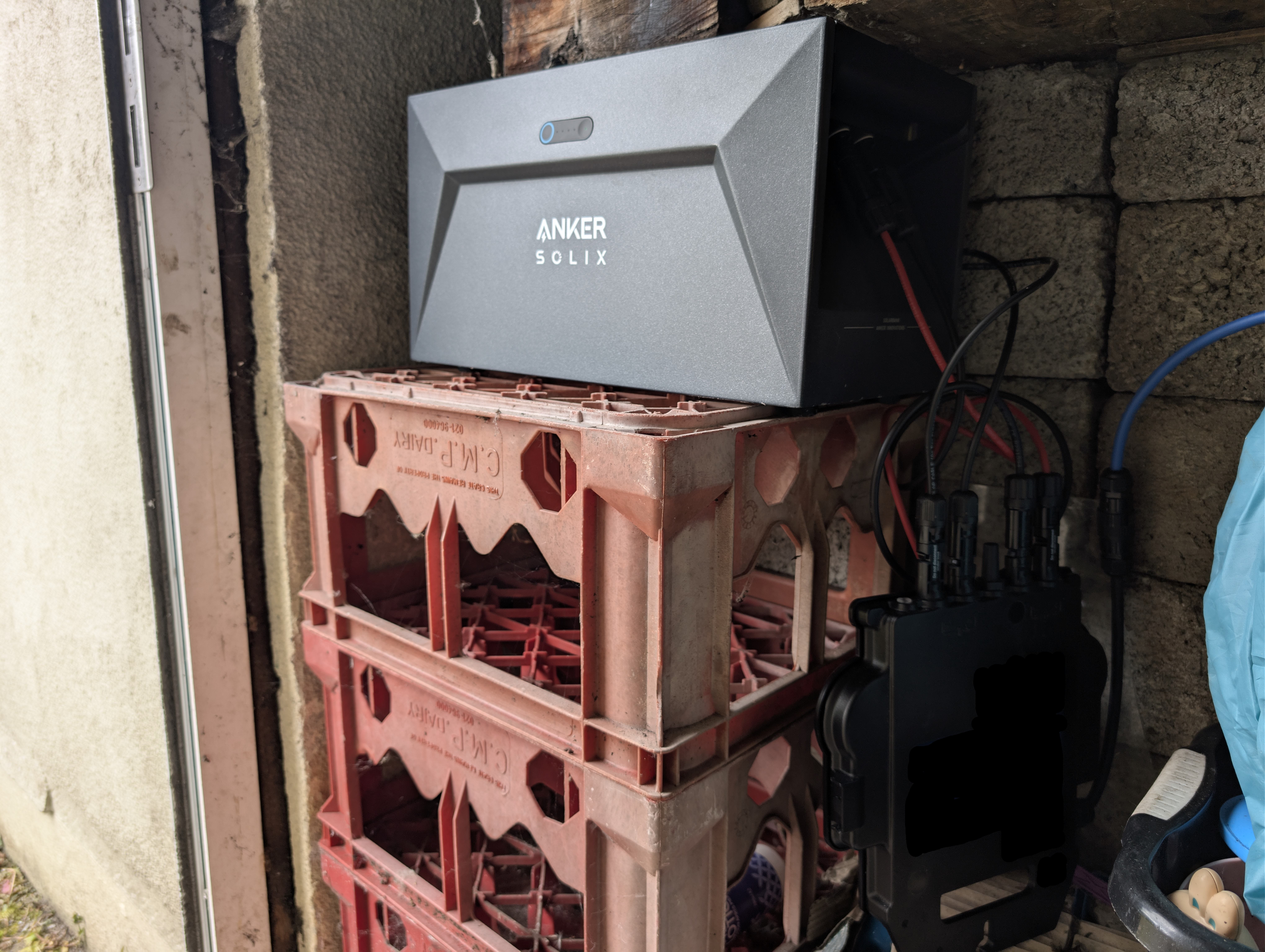
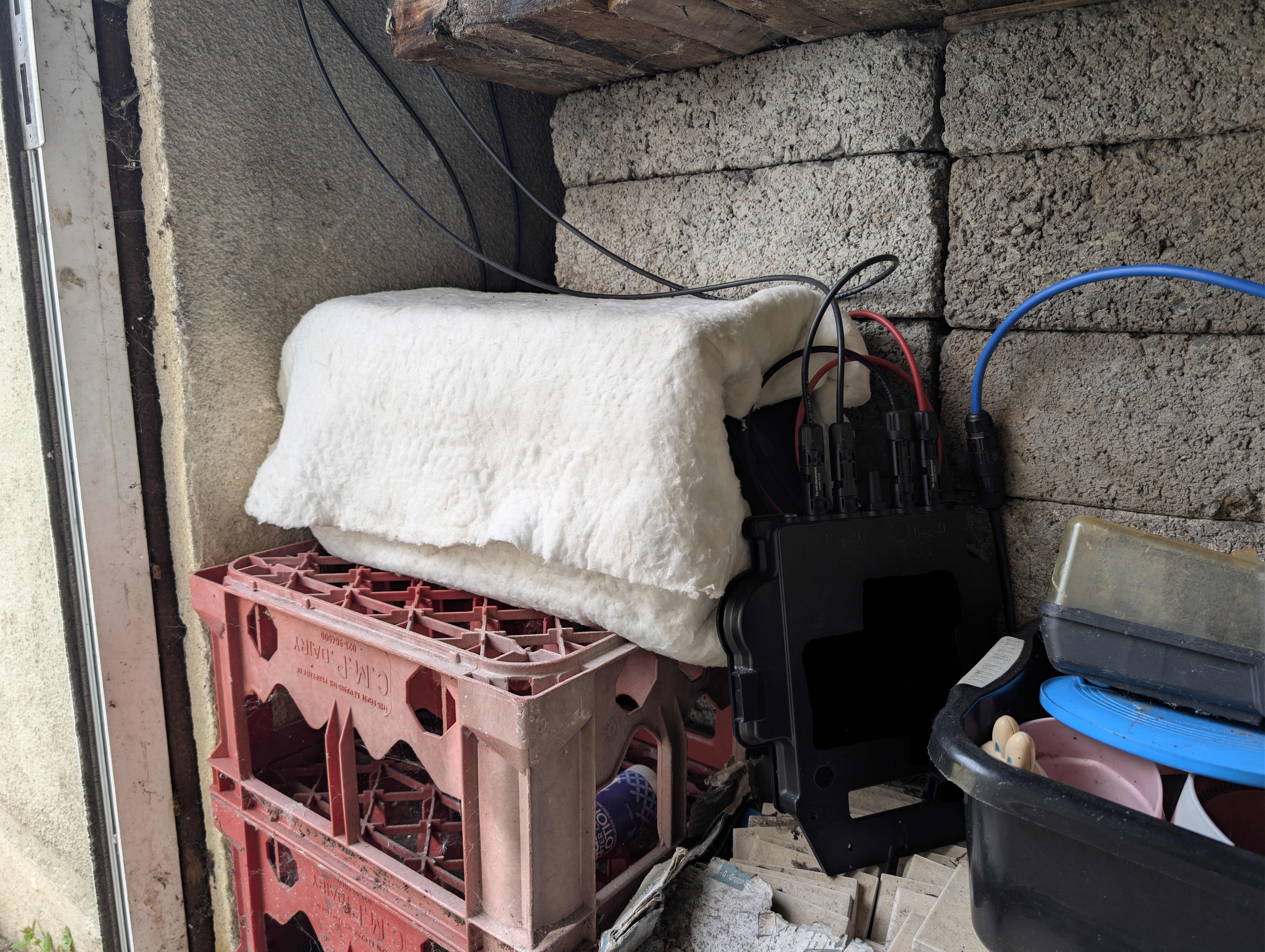
Before and after applying the ceramic fibre insulation
blanket
(the reason that I blacked out the inverter labels is because anybody with the inverter serial number can remotely hijack it, see below)
10 mm of blanket doesn’t cost much, and it’ll greatly reduce the amount of time that the battery heating coils need to run. The great thing about insulation is that the first few millimetres always has the best bang for the buck – even ten cheap millimetres makes a big difference.
Finally, I just want to point out that the fact that I can write out so much precise detail about device behaviour is because so many (mostly German) end users had documented this device’s real world behaviours. Anker certainly didn’t document most of it, though they seem to have partially caught up via their website’s FAQ, if not by updating the product’s manual. If you were looking at an unbranded solution off Aliexpress, then nothing would be documented and all these behaviour quirks would be 100% on you to figure out. By choosing a branded and popular solution, you get a head start on figuring out ‘why is this device behaving the weird way it is?’. And the mature open source ecosystem for integration is certainly worth the small added cost for purchase over an unbranded system.
What to take away about the Anker Solix Solarbank E1600 gen 2
After all that detail, it won’t be obvious that to maximise solar yield you attach dedicated panels directly to the inverter so those can contribute to the house while another dedicated set of panels charge the battery. If you choose the split of panel allocation to match your environment and hardware, you can ensure that the battery usually gets to 100% before 3pm when the house power consumption starts to rise, and therefore the Anker box enters bypass mode due to battery full and the inverter gets all panels from which to supplement the house during the peak consumption hours. Then when the sun sets the battery starts to discharge, and if you configure things right it’ll be nearly empty by 11pm when the day rate ends, and anything left over can be discharged from 8am onwards the following morning.
In other words, completely ignore the fixed shunt ratio functionality. It’s an idea that looks good on paper, and maybe it works better in climates with constant blue skies where the wastage won’t matter as much. But here in Ireland where wastage really matters a lot, just forget about that feature entirely. Plan around the battery storage being in one of (i) charging (ii) bypass (iii) discharging and exclusively one of those three.
I ended up wiring my strongest panel directly into the inverter, and the other three panels in parallel into the battery storage. My panels are all STC rated for 375 watts each, and under ideal circumstances you can see 400 watts off a single panel. In the much more common overcast day you get in Ireland, one third of STC is about right, so ~125 watts per panel. This means three panels generate around 375 watts, and given that the Anker box limits charge rate when it’s cold that’s about right. At 375 watts it takes about five hours to charge to full, so if it starts charging at 9.30am (which it does because I told it to do so via timetable) then it becomes full by around 2.30pm on a bright overcast day. This is exactly matches our period of lowest day rate electricity usage, and during which a single panel will cover more than half the house power consumption. Once the battery is full, it then enters bypass mode and all four panels are available to the inverter to supplement the house’s current electricity consumption.
Come 5pm, my timetable forces the battery into discharge, so peak time electricity always gets the battery to draw from and the single panel is also available to draw from if the day remains bright. We cap the discharge rate to 230 watts so the battery runs down to around 20% remaining by 11pm after which we turn everything off until 8am the following morning. Between 8am and 9.30am we force the battery into discharge to offset the morning electricity usage spike, then from 9.30am onwards the battery charges as quickly as possible. We rinse and repeat that daily. We therefore offset as much day rate and peak rate electricity as is possible with this single inverter based design of system, which might be around 5 kWh per day on a typical overcast day, or €1.68 per day, which might be worth €352 per year of bill savings. This is obviously well less than planned for above thanks to the single inverter design limitations, but it would repay my own personal investment within eighteen months, and as I mentioned, I expect to transplant this system into my Dad’s house once we move out from this rented house.
Note that one useful feature of micro solar is that because you’re only ever aiming to offset the baseline X kWh off your bill, it doesn’t matter when you offset a kWh so long as it’s done during day or peak rate hours. Obviously, ideally you want to offset more of the peak rate when you can, but that’s exactly the topic for the next diary entry – if any of that is too complicated, you can legitimately set this thing to trickle out the power during day and peak rate hours and get most of the savings possible. As you’ll see next post, I’ll be reducing the fixed trickle out rate from 230 watts by a bit, but only if we burst output 400 watts during peak hours due to household load. In other words, given that peak rate is only a bit more expensive than day rate, it won’t save much more of my bill, maybe a few euro per year. In any case all that is for next entry not now.
To be extra extra clear, before we move on from the Anker Solix Solarbank E1600 gen 2 I cannot stress this point enough:
If you’re buying a new balcony inverter with storage, buy a system capable of simultaneous charge and discharge i.e. dual converters e.g. the Anker Solix Solarbank 2 E1600 Pro, the Anker Solix Solarbank 2 E1600 Plus, or the Marstek Venus A. Do NOT under ANY CIRCUMSTANCES waste your money on a single converter system in 2026!
I knew all this before my order to Aliexpress – unfortunately what turned up was this single converter system, not the one I ordered. As Aliexpress weren’t going to let me return it, I’ve made do with this 2023-era system. In 2026, less compromised more efficient designs cost only a little more, and you should choose those instead!
The APSystems EZ1-M balcony inverter
Being in the ‘fortunate’ position of having to choose my balcony inverter to match my battery storage rather than the other way round, I had a few choices within the sub-€120 price range:
- Hoymiles HMS-800W-2T. The most popular choice in Germany. Not a great choice for combining with the Anker Solix though as it has max 14 amps per MPPT input AND it can’t yield more than 400w if only one input is used. In other words, it would underperform in my 3 + 1 panel configuration. Though, see below about that.
- Growatt NEO 800M-X. Has class leading 23 amp inputs, plus it can generate all 800w off one input, but needs a high input voltage (28v!) to start so you lose your mornings and evenings for yield.
- Marstek MI800, cheapest of them all and no reported issues except for its max 16 amps per MPPT input. Low 22v start voltage.
- APSystems EZ1-M. Has 20 amp inputs, input start voltage is 26v which isn’t the best but also not the worst. BIG tick in favour is an official local REST API for control and very rapid output response to it being told a new power to output (i.e. if you can read grid mains power consumption, you can script REST API calls to the inverter and it’ll respond quickly). Another tick in favour is that the official Anker micro inverter for the Solix Solarbank E1600 is a rebadged APSystems EZ1-M, so same hardware and mildly different firmware. Unsurprisingly, the Anker app treats the EZ1-M inverter specially compared to others. Note that the official Anker MI80 inverter costs at least €180 and usually more, and the EZ1-M is a lot cheaper.
There are many other low cost balcony inverter choices incidentally – especially unbranded balcony inverters from Aliexpress and others – but the above are the main lowest price branded balcony inverters as of Q2 2026.
I ended up plumping for the APSystems EZ1-M principally for its official local REST API, because now it’s dead easy to integrate into pretty much everything (unlike the Anker device, which needs an enthusiast maintained library such as https://github.com/thomluther/anker-solix-api). Some of the devices listed above also have open source ecosystem integrations, but all have caveats and there is nothing better than an officially supported local API. Another factor was the high input amps capability, if this balcony inverter ever gets used for something else then the higher amp input range would be useful.
Unfortunately, a bit like with the Anker Solix Solarbank E1600 gen 2, my own personal testing of the APSystems EZ1-M has revealed convenient failures to document actual behaviours and other quirks. Firstly, maybe it’s the firmware that the Anker app insisted be flashed onto it (v2.1.4_b), but this inverter is only capable of yielding a maximum 400 watts per MPPT input. So if you have 600 watts available on one input, it’ll only draw max 400 watts from that, like the Hoymiles inverter above. Secondly, its Wifi antenna is absolutely crap, and even with a nearby Wifi AP you’ll struggle to reliably communicate with it – you’ll see a lot of timeouts for your REST API requests. So driving this thing to prevent export to the grid is tricky just from that standpoint. Suffice it to say that I am disappointed in my choice, and as you’ll see next paragraph the open REST API actually turns out to be pretty useless when this device is combined with the Anker device – if doing this again, the Marstek MI800 as the cheapest of the lot would be my preference.
Unfortunately, there is a much bigger problem: there is something about how the EZ1-M throttles its input when it’s restraining its output to meet your configured setting which sometimes upsets the Anker Solix Solarbank E1600, causing the latter to enter an error state and halt output. This happens infrequently, it could run for a day without issue, but then another day it’ll trip out two or three times in a day. And the Anker Solix won’t resume output until you physically press a button on its front, for which you need to notice that it has tripped out. This, needless to say, is immensely frustrating.
The EZ1-M uses very typical budget balcony inverter hardware, and thanks to a reverse engineered firmware (https://github.com/Fexiven/open-apsystems) which replaces the firmware with a pure ESPHome image, we know that the processor which does the inverting is a TI C2000 DSP. The user facing front end runs on an ESP32-C2, and it tells the DSP what to do via a UART connection. The TI C2000 is a very low end CPU, but it appears to come in a preconfigured and pretested budget solar-inverter-to-grid push module, so it’s probably cheapest to whack one of those in and have the ESP32 implement the Wifi, Bluetooth etc side of things. As far as I can tell, all the branded balcony solar inverters under €150 use nearly identical hardware, so if the Anker Solix dropout issue occurs with the EZ1-M – which is identical hardware to the official Anker MI80 inverter – then it’ll occur with all other solar inverters.
And indeed, searches of balcony inverter forums reveal this is exactly correct, and is why when I said above ‘It is considered one of the most frustrating balcony solar products of the past three years’, this is what I was referring to.
But surely, you might ask, how then does the official Anker MI80 inverter work seamlessly with the Anker Solix Solarbank E1600 without random drop outs? It turns out that the official Anker MI80 inverter is configured to never throttle at all, it always outputs the maximum it can draw. Instead, it’s the Anker Solix Solarbank E1600 which implements the output throttling. Once you realise this, the system finally behaves in a stable fashion:
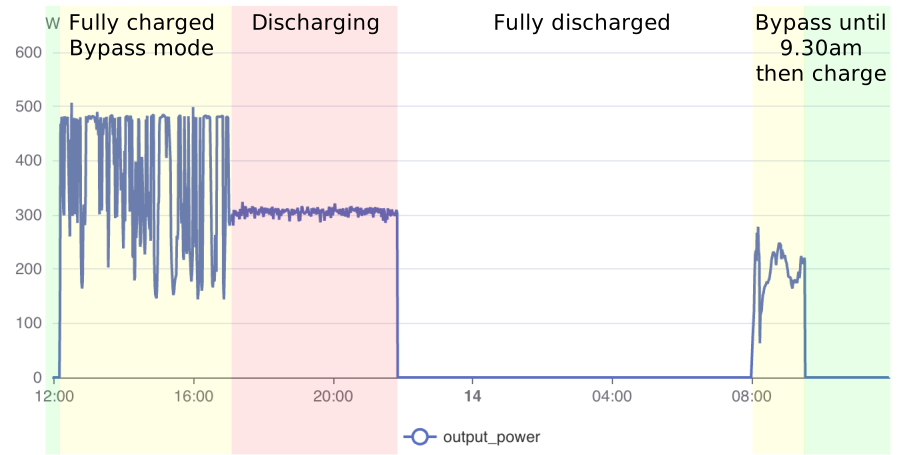
And we finally have a reliable, working solution! It took me three weeks of trial and error to reach what I just described. I knew it was possible to build a reliable system from these parts as thanks to dialogue on the German Balkonkraftwerk forums I knew that it was possible. It’s just nowhere actually wrote out the specific configuration and settings for this specific hardware combination. And now somebody has: me.
Before I move on, I ought to mention that the APSystems EZ1-M balcony inverter is exceedingly easy for malicious third parties to hijack. You can read all about that at https://jakkaru.de/articles/apsystems-remote-firmware-injection, but in short you really need to keep other devices away from talking to this inverter as anybody with access to the REST API can push any firmware to the device without limitation. This is great if you want to write a custom firmware onto the device – very refreshingly old school – but seeing as any device on your network can gain a permanent foothold into your network via this wide open exploit mechanism, you would be wise to secure network access to this inverter and only allow whitelisted devices access. The easiest way to implement this is via VLANs, so via OpenWRT you put the inverter onto its own, segmented, Wifi + VLAN and then permit only say your OpenHAB controller access to that VLAN so values can be read. Under NO CIRCUMSTANCES should you permit the EZ1-M access to the public internet. Also, under NO CIRCUMSTANCES should you permit the EZ1-M access to any other device in your network.
And if you do so anyway, also be aware that anybody with your inverter’s serial number can do a man-in-the-middle attack to remotely push a malicious firmware upgrade to your specific inverter. The serial numbers do appear to be fairly randomised, so there is that, but yeah that’s how much you really need to keep this inverter away from the public internet. Oh, and finally, just to get even better, this inverter never turns off its Bluetooth and always allows wide open access. So anybody with a Bluetooth gun can upload any firmware they like from outside your house, and they now have a foothold into your network. So you really DO need to prevent this device from having any access to anything else – give it its own Wifi AP and its own VLAN and firewall it off from everything.
Unfortunately, you’ll probably have no choice but to permit the Anker Solix Solarbank E1600 access to the internet, as you have two choices for controlling it: (i) its Bluetooth API and (ii) its cloud API. Both have very mature open source support, but as I didn’t want to spend more money on Bluetooth repeaters when I’ll have zero use for those down the line (I’m far more amenable to Zigbee repeaters, as those I know I’ll use in the future), I ended up punching a hole through the VLAN just for this device to reach the Anker cloud. The device itself has no concept of the current time of day, so won’t execute its programmed time plan on its own – it gets commands pushed at it by the Anker cloud or the Anker app on your phone. At least this makes command and control easy – you tell the Anker cloud of a new plan, and it’ll push that to the device – but it’s all so very not private plus with a very obvious single point of failure. As I mentioned above, if this installation were more permanent I’d use the Bluetooth based control and dispense entirely with brittle cloud based functionality. But, for now, for this specific installation, cloud based control will do.
That’ll be where part two of this series of diary entries begins: how do you go about ensuring that this system doesn’t export power to the mains grid? Expect another long entry full of technical detail soon!
What would I recommend to somebody wanting to fit Balcony Solar in Ireland in 2026 for under €1,000?
As listed above, you can get right now four used solar panels making up 1,800 watts of electricity gathering power, plus wall brackets and cables for €353 inc VAT and delivery (excl delivery of the panels, you’ll need to go collect those yourself).
After my super fun times with the Anker Solix Solarbank E1600 and the APSystems EZ1-M, I would doubt that the Marstek Venus A could be more hassle to get working well. You can get one of those delivered to Ireland from Germany including 23% VAT for €638 right now. That’s €991 inc VAT inc delivery all in for a 2.12 kWh battery storage system with simultaneous charge-discharge inverter AND a bundled mains power meter to prevent export to the mains grid. As it can also charge itself from the mains grid, in the winter months when there is no sunshine you can have it charge using night rate electricity and offset expensive day rate electricity. It of course has its own cloud based control system with mobile phone app and all that is leaky for privacy and concerning for single point of failure, so whilst being easy for the average home owner there are concerns. There is a Modbus API, but apparently using it will crash the device periodically causing factory reset. That’s probably scriptable around, but maybe sticking with their cloud based control system would be wiser for this brand.
Specs wise it’s one hell of a lot of kit for the money, and you should get ~7 kWh per day of day rate savings out of it in the summer months and save maybe 0.7 kWh per day of day rate savings in the winter months. That is about 1,575 kWh per year, worth about €525 of savings per year, so your investment should be fully paid off within two years.
And that is with zero subsidies from the government! If you have the space for the panels, you’d be mad to not fit one of these in Ireland right now. And if in the future Ireland does legislate for balcony inverters to enable you to get paid for exporting power without needing a RECI electrician to submit a certificate, the return on investment time on these gets a lot better again. Here’s hoping!
| Go to previous entry | Go to next entry | Go back to the archive index | Go back to the latest entries |