Word count: 2534. Estimated reading time: 12 minutes.
- Summary:
- The site’s fibre broadband connection was switched from Eir to Digiweb, resulting in a change in ping times and throughput. Packet loss and latency spikes were observed during peak residential traffic hours in the evening with Digiweb, but were steady and flat outside of this period. The new connection is shared between multiple customers, with a contention ratio of 32:1 for residential connections.
Friday 13 February 2026: 11:46.
- Summary:
- The site’s fibre broadband connection was switched from Eir to Digiweb, resulting in a change in ping times and throughput. Packet loss and latency spikes were observed during peak residential traffic hours in the evening with Digiweb, but were steady and flat outside of this period. The new connection is shared between multiple customers, with a contention ratio of 32:1 for residential connections.
Firstly, can you believe it’s been two years since fibre broadband was installed into the site? It was in January 2024, a few months after fibre broadband to the home (FTTH) was installed into the site’s village and became available. Before that, I had for the preceding six months run a Starlink satellite broadband which was not terrible, but it was a power hog (130w!) and it had a constant, though very low, rate of packet loss due to satellites moving around. Starlink is very definitely better than 4g based internet, probably better than vDSL, but not as good as a fibre connection which is very hard to beat if the underlying backhaul is up to snuff.
Because FTTH had only just been made available, at the time only Eir could see that the property had the possibility of fibre installation. Also, at that time, fibre broadband was expensive across the board, and a once off installation fee of €150-200 was common. If I went with an expensive Eir 1 Gbps business connection with a 24 month contract, they would do the first time installation for free, and at that time the monthly fee of €78.62 inc VAT was not terrible (Starlink’s was €61.50 inc VAT excluding the dish, and I remember most fibre broadband back then was around the €60-65 per month mark).
Obviously, where they catch you is (a) 24 months of paying €10-15 more per month easily pays for the ‘free’ installation and (b) prices for fibre broadband were surely going to drop over those two years, but you’d be locked into the 24 month contract. And that’s exactly how things played out: ten months ago I had fibre broadband installed into my rented home which had free first time installation and yet a monthly fee of just €35 inc VAT with a twelve month contract. That was a 500 Mbps connection, and the new contract at the site is for a 1 Gbps connection for a mere €30 inc VAT monthly for a 12 month contract. That’s a lot of forward progress on bandwidth per euro in just two years, we are doing better than doubling the value per euro per year!
That of course makes you wonder about the quality of the network as that would be the obvious place to economise. The Layer 3 backhaul for both the site and my rented home is OpenEir, however each ISP runs its own Layer 4 on top. Some providers (Eir, Sky) use straight DHCP like a LAN, however most appear to use PPPoE which is unfortunate, as it is inferior, and as far as I can tell there is no good reason to continue to do so in modern systems especially as the username and password is identical for all customers in an ISP. I assume it’s a legacy systems thing, a left over from ADSL days, perhaps because their billing and management systems won’t then need upgrading.
As noted when I installed the fibre broadband into my rented house, there are random bursts of packet loss and ping time spikes for the rented home fibre broadband connection. I don’t know if that’s the ISP (Pure Telecom) which uses BTIreland for Layer 3 backhaul, or the G.hn powerline network between the Fibre ONT and my outermost router, but in any case it persisted over most of this year only suddenly getting better from December onwards, and it now looks like this:
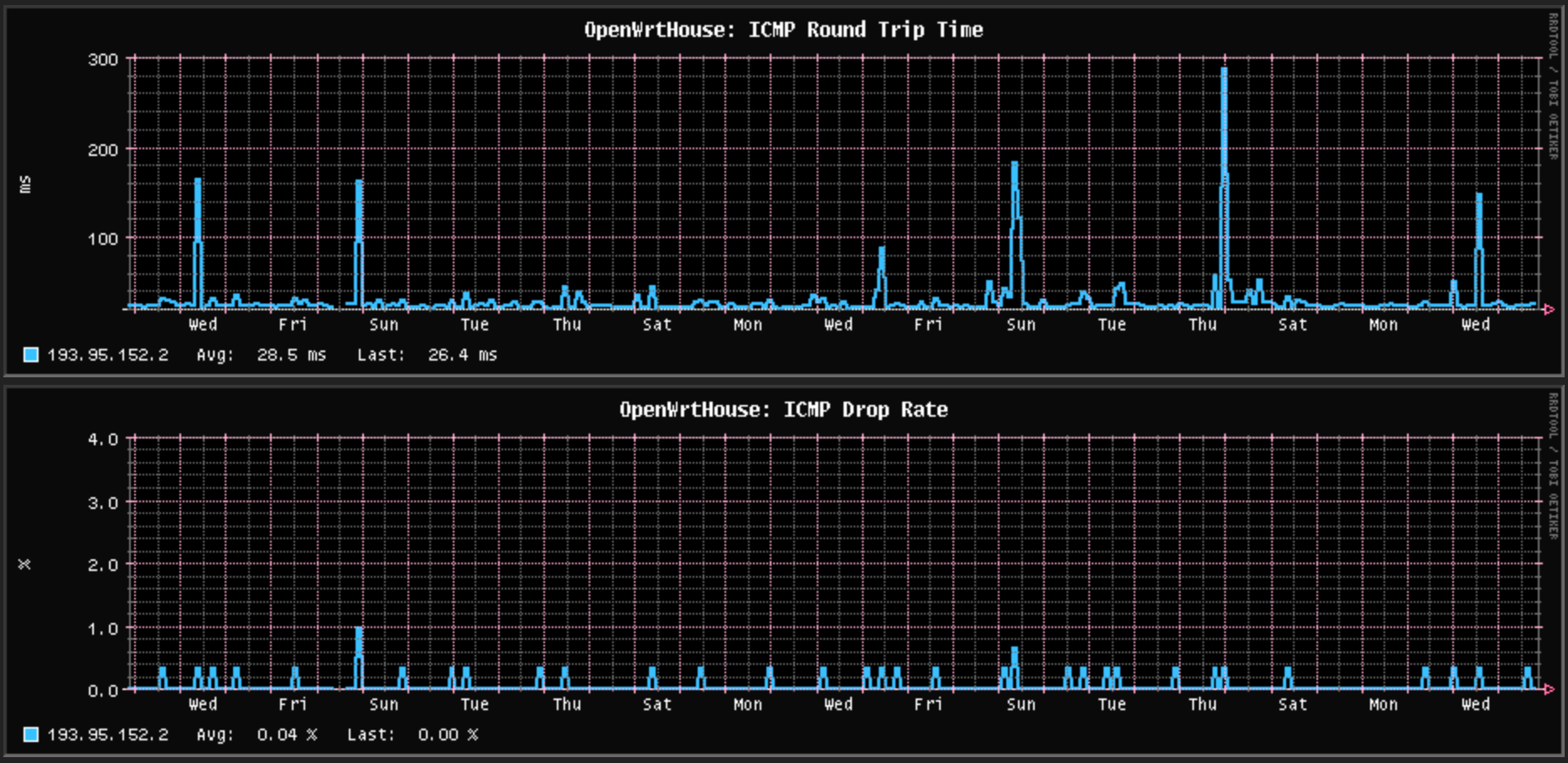
The past month of packet loss and latency spikes with the rented home fibre broadband
This is actually much better than it was for the majority of last year – there was far more ping time noise and it meant constant spikes in standard deviation while the connection was idle. Since December, that noise is so reduced it doesn’t show up in standard deviation even when the connection is downloading something at maximum speed, and I haven’t changed anything in the house so I assume Pure Telecom/BTIreland fixed something.
Obviously I only have a few hours of Digiweb ping times to look at, however so far I’d say they look a little more noisy that Pure Telecom’s during the peak residential traffic hours in the evening, but outside that they’re pretty much a steady flat 8-9 ms. There hasn’t been enough time to see if any ping requests get dropped.
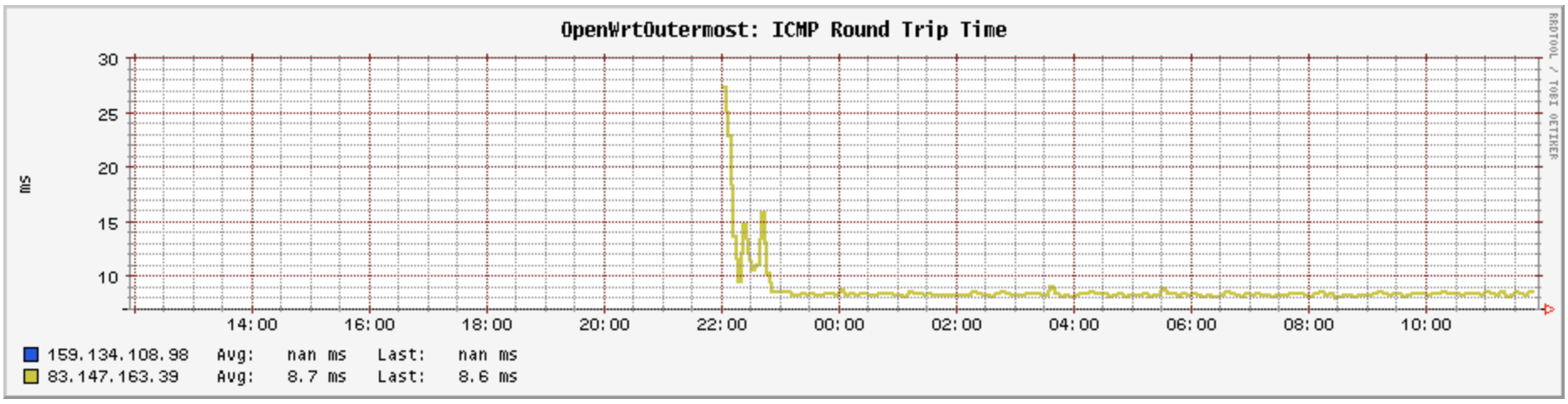
The past day of packet latency with the new site fibre broadband
Eir also had a flat as a pancake ping times (8.8 to 9.2 ms with a very occasional spike to … wait for it … 10.1 ms! every two months or so), but unlike Digiweb that was the case all day long every day with no sensitivity to evenings. However the Eir package was a business connection where its traffic gets priority over residential traffic, so it’s not surprising that ping times would be so consistent when you’re not competing with much other traffic at all.
Anyway, to the benchmarking! Here are the round trip times for each of those ISPs to various locations around the world, and remember lower is better for this graph:
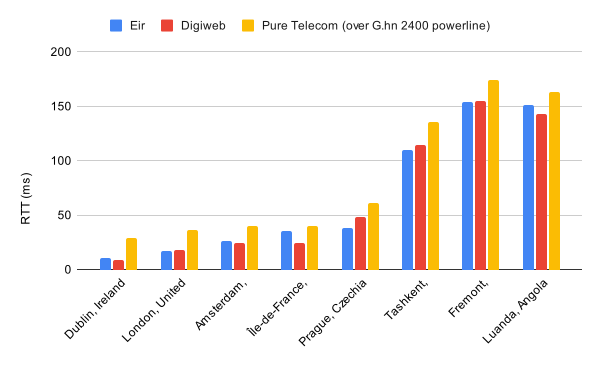
As empirically tested in the article about the G.hn powerline adapters, they have a configuration option which lets you choose between power conserving and performance. I have mine on power conserving, so they go to sleep in between ping packets and thus they add ~18 milliseconds to ping times. In fact, if you can get the traffic rate up a bit, they won’t go to sleep and ping times drop dramatically, so the above graph looks worse than it is if you were maxing out a download. Where the G.hn powerline adapters particularly impact things is throughput which is basically capped to ~100 Mbps per connection, so you’ll need to use multiple connections to max out the speed. As all the locations will see 85 - 100 Mbps in this benchmark no matter where in the world, I left off the Pure Telecom results for this graph comparing single connection throughput to the same locations around the world:
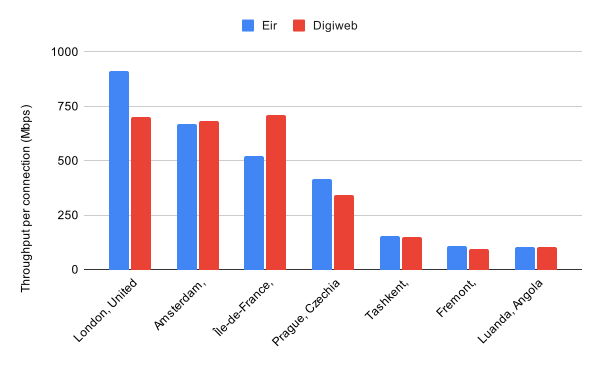
This is with the default Linux TCP receive window of 3 Mb which I used as most people don’t think of fiddling with that setting on their edge routers. As you can see, Eir and Digiweb are very similar at distance, Digiweb is a good bit worse to London and Czechia, better to Paris and about equal to Amsterdam. This exactly matches the RTT ping time difference above, so these are exactly the results you would expect given those ping times.
So why are the ping times so different? Eir peers with Twelve99 in Dublin, it routes via AS1273 Vodafone/Cable & Wireless straight into Central Europe, and it is therefore close to Czechia and a bit further away from London and Paris. Both Pure Telecom via BTIreland and Digiweb via their connectivity provider Zayo route to London, and then via Paris to the final destination. Eir routes US traffic using Hurricane Electric via Amsterdam, whereas both BTIreland and Zayo route to the US via London. Interestingly, Eir is slightly faster to reach Los Angeles despite Amsterdam being further away spatially.
In short, routing data the cheapest way is not the fastest way, and packets can take longer than optimum journeys over space to get to their destinations. We can thusly conclude:
- As all fibre broadband in Ireland apart from Eir always goes to INEX Dublin, it is always min 10 milliseconds to get anywhere.
- As all traffic apart from Eir leaving Ireland always goes to London first, it is always min 18 milliseconds to get anywhere outside Ireland.
- As all traffic reaching continental Europe takes at least 25 milliseconds to get there thanks to all the switching and distance, you’re already on a relatively high latency connection by definition (in case you were interested, internet traffic runs at 55-65% the speed of light between Ireland and Europe/US, with the maximum possible speed in fibre optics being 68% the speed of light). Continental Europe, in terms of internet cables, is a minimum 1,200 km away in the best case. Light within glass takes what it does to traverse that distance (about 17 ms).
The reason I’m raising minimum latencies to get anywhere is because the default maximum TCP receive window of 3 Mb in Linux creates the following theoretical relationship of throughput to latency:
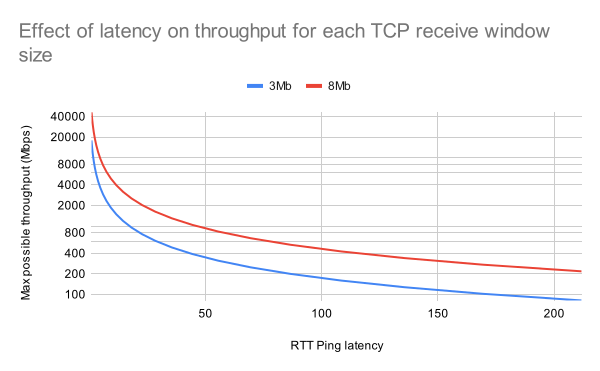
In other words, to achieve 1 Gbps in a single connection with a 3 Mb TCP receive window, your RTT ping latency cannot exceed about 17 ms. Or, put another way, the only way you’ll see your full 1 Gbps per single connection is if you exclusively connect to servers either in Ireland or Britain only.
As the graph above suggests, increasing your TCP receive window to 8 Mb increases your RTT ping latency maximum for a 1 Gbps per single connection to 45 ms which is enough to cover most of continental Europe. In case you’re thinking why not increase it still further?, you’ll find that the server will also have its own maximum send window, and a very common maximum is 8 Mb at the time of writing. Increasing your receive window past the sender’s window does not result in a performance gain, and the larger your receive window the more latency spikes you’ll see because the Linux kernel has to copy more memory around during its garbage collection cycles. So you can actually start to lose performance with even larger windows, especially on the relatively slow ARM Cortex A53 in order CPUs typical on router hardware.
Thankfully Linux makes increasing the TCP receive window
to 8 Mb ludicrously easy. Just add this to /etc/sysctl.conf:
net.ipv4.tcp_rmem = 4096 131072 16777216
This will work on any kind of recent Linux including OpenWRT and you almost certainly should configure your edge router this way if you have sufficient RAM for it to make sense. Linux will dynamically allocate up to 16 Mb of RAM per connection for the TCP receive window, of which up to 50% forms the TCP receive window. Recent Linuces will automatically scale the window size and the memory consumed based on each individual connection so you don’t have to do more to see a 2x to 3x throughput gain from a single line change. In case you’re wondering what happens if there are thousands of connections all consuming 16 Mb of RAM each on a device with no swap, you can relax as Linux will clip the maximum RAM per connection automatically if free RAM gets tight. Equally, this means that changing this parameter will only have an effect on router hardware with plenty of free RAM. Still, you can set this and nothing is going to blow up, it’ll just enter a slow path under load on RAM constrained devices.
1 Gbps broadband appears to be the price floor as of this year in Ireland – the 500 Mbps service is barely cheaper if it is cheaper at all (for the site when I ordered the Digiweb package their 500 Mbps and 1 Gbps packages were identically priced under a ‘New Year special offer’), and from my testing above it would seem that at least both Eir and Digiweb are providing a genuine true 1 Gbps downstream from the public internet, albeit obviously shared between however many residential customers at a time. The next obvious step for next year’s competitive landscape is a new price floor of 2 Gbps for residential fibre broadband where it doesn’t cost much more than 1 Gbps. OpenEIR was built with up to 5 Gbps per residential user in mind, after that things would get a bit tricky technically speaking. But, to be honest, I find 2.5 Gbps ethernet LAN more than plenty, and my planned fibre backhaul for my house is all 2.5 Gbps based principally because (a) it’s cheap (b) it’s low power and (c) again, genuinely, do you really ever need more than 2.5 Gbps except on the very occasional case of copying a whole laptop drive to backup?
The Bluray specification maxes out at 144 Mbps though few content ever reaches that – a typical 4k Ultra HDR eight channel video runs at about 100 Mbps. High end 4k video off the internet uses more modern compression codecs, and typically peaks at 50 Mbps. You could handily run twenty maximum quality Bluray video streams, or forty maximum quality Netflix video streams on a 2 Gbps broadband connection. As most households would probably never run more than four or five of those concurrently (and usually far less), I suspect the residential market will mainly care about guaranteed minimum 100 Mbps during peak evening hours rather than maximum performance in off peak hours.
That brings us back to contention and how densely is backhaul shared across residential homes. Back in vDSL days, I paid the extra for a business connection into my rented house because vDSL broadband became noticeably sucky each evening, so by paying extra for my traffic to be prioritised over everybody else’s I had good quality internet all day long. Fibre to the cabinet (FTTC) which was what vDSL was typically had 48:1 contention ratios for residential connections, but 20:1 plus priority traffic queue for business connections. I had assumed that fibre broadband would have a similarly sucky experience in the evenings, but so far it’s been fine with Pure Telecom in my rented house. Time will tell for Digiweb at the site.
OpenEir uses a contention ratio of 32:1 for residential connections, but that’s of a 10 Gbps link so you always get a guaranteed minimum of 312 Mbps per connection. As noted above, due to the G.hn powerline in between the ONT in my rented house we are capped to about that in any case, so it’s unsurprising I haven’t noticed any performance loss in the evenings. 312 Mbps is of course plenty for several concurrent 4k Netflix video streams, so I suspect so long as streaming video never stutters, 99.9% of fibre broadband users will be happy.
In fairness to governments, though it took them twenty years, they do appear to have finally solved ‘quality residential internet’ without any major caveats. I remember paying through the nose for cable based internet in Madrid back around the year 2000. It was the fastest package they had at 1 Mbps, and you usually got about 75 Kb/sec downloads off it. Back then hard drives were small, so you basically had it downloading 24-7 and you wrote out content to DVDs – I remember hauling a very heavy backpack stuffed with DVDs through the airport when I emigrated back to Ireland. A different era!
| Go to previous entry | Go to next entry | Go back to the archive index | Go back to the latest entries |