Word count: 5240. Estimated reading time: 25 minutes.
- Summary:
- The 400b? full fat Claude Sonnet 4.5 model does by far the best summary, while the Qwen3 30b model is obviously a lot more detailed than the Llama3.1 8b model but misbalances what detail to report upon and what to leave out. The Llama3.1 8b produces a short summary consisting of only what it thinks are the bare essentials, and I would personally say it’s a fairly balanced summary choosing a fair set of things to report in detail and what to omit.
Friday 30 January 2026: 19:39.
- Summary:
- The 400b? full fat Claude Sonnet 4.5 model does by far the best summary, while the Qwen3 30b model is obviously a lot more detailed than the Llama3.1 8b model but misbalances what detail to report upon and what to leave out. The Llama3.1 8b produces a short summary consisting of only what it thinks are the bare essentials, and I would personally say it’s a fairly balanced summary choosing a fair set of things to report in detail and what to omit.
Still, that’s expensive for a shell, you’d expect about €1,000-1,200 inc VAT per m2 for a NZEB build. Obviously we have one third better insulation which accounts for most of the cost difference, but some of the rest of the cost difference is the considerable steel employed to create that large vaulted open space. We should use 4.3 metric tonnes of the stuff, and thanks to EU carbon taxes steel is very not cheap in Ireland.
To get it to weathertight, I expect glazing will cost €80k inc VAT or so. I have no control over that cost, so it is what it is. The outer concrete block I also have no control over that cost, blocks cost at least €2 inc VAT each and the man to lay them is about the same. The QS thinks that the exterior leaf will cost €25k, and the render going onto it €49k – I have no reason to disbelieve him, and again I have no control over that cost, so it is what it is.
Where I do have some control is for the roof. The QS budgeted €46k for that. I think if we drop the spec from fibre-cement tile to cheapest possible concrete tile and I fit the roof myself I can get that down by €30k or so. I put together this swinging arm and electric winch for lifting up to 100 kg of tiles at a time to the roof, it clamps onto scaffolding as you can see, and this should save us a lot of time and pain:
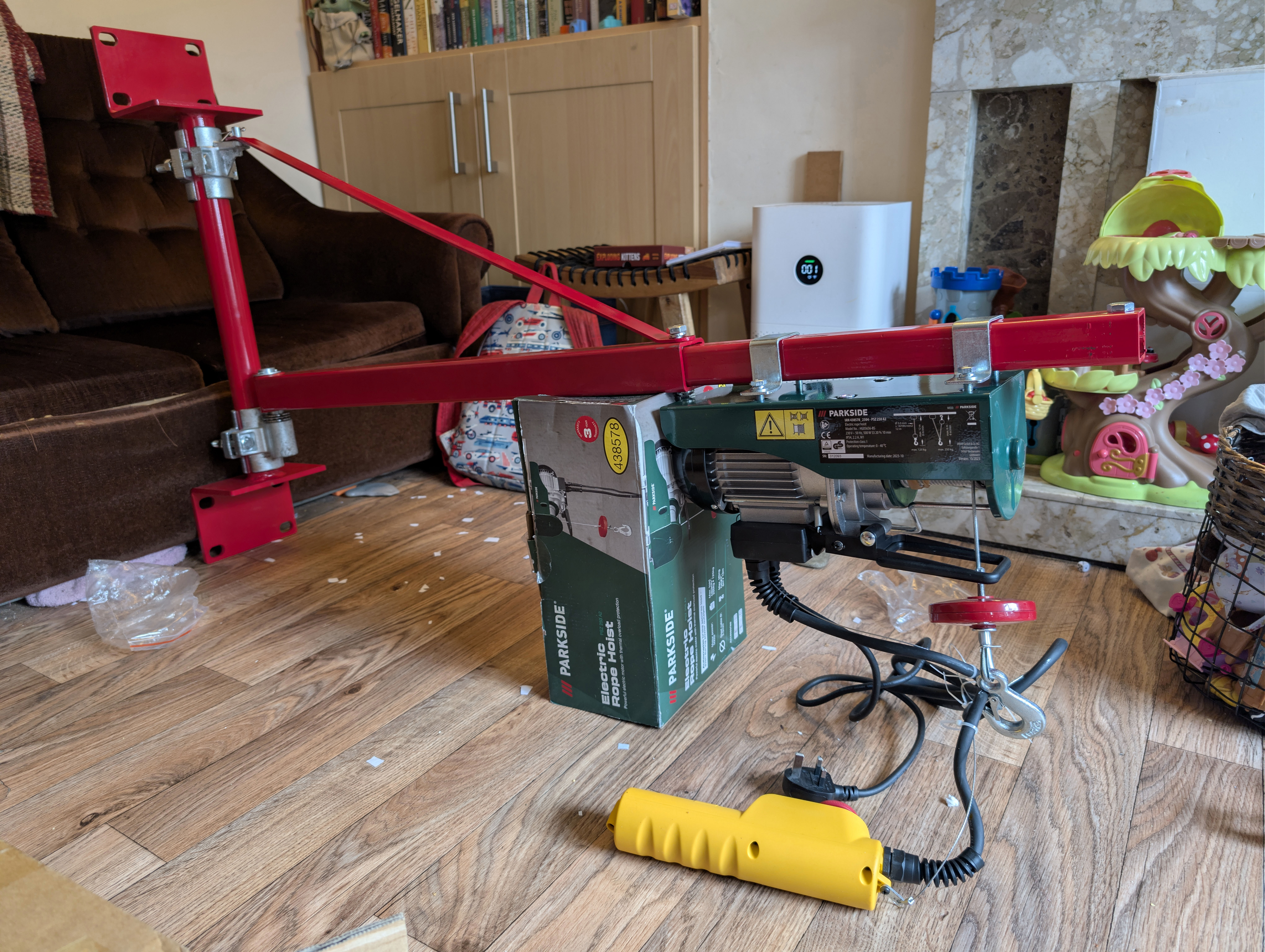
Put together for under €150 inc VAT delivered, the arm can extend to 1.2m and can lift up to 300 kg. The winch can only manage 250 kg at half speed, 125 kg at full speed.
Saving 30k on the roof doesn’t close the funding gap to reach weathertight, but it does make a big difference. It would be super great if a well paid six month contract could turn up soon, but market conditions are not positive: there is a very good chance I’ll have zero income between now and when the builder leaves the site.
I have no idea from where I’ll find the shortfall currently. What I do know is that next year planning permission expires as it’ll have been five years since we got the planning permission. We need the building to be raised and present ASAP. We’ll just have to hope that the tech economy improves, for which I suspect we need the AI bubble to pop so the tech industry can deflate and reinflate and the good work contracts reappear. I’ll be blunt and say I find it highly unlikely it can pop and recover within the time period we need, so I just don’t know. Cross that bridge when we get to it.
Anyway, turning to more positive topics, as there has been forward progress on the house build I’ve forced myself to work further on the services layout as I really hate doing them, so me forcing myself to get them done is a very good use of my unemployment time. Witness the latest 3D house model with services laid out:
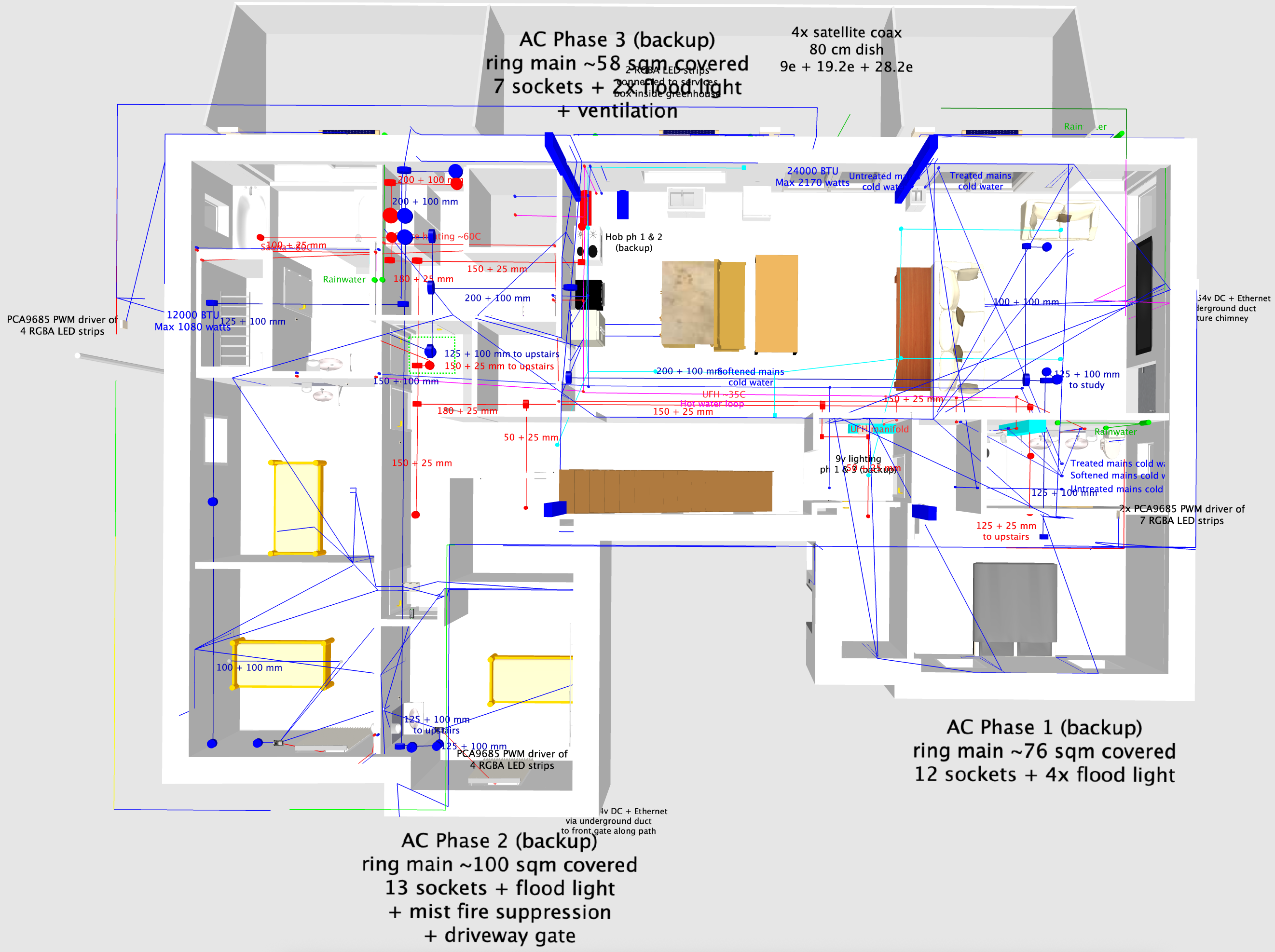
I use a free program for this called Sweet Home 3D which has a ‘Wiring’ Plugin which lets you route all your services. The above picture overlays all the service layers at once which is overwhelming detail, however each individual service e.g. ventilation, or AC phase 1, is on its own individual layer. You can thus flip on or off whatever you are currently interested in. This 3D model is made in addition to the schematic diagrams drawn using QElectroTech which I previously covered here, and both are kept in sync. The schematic diagrams are location based, so if you’re in say Clara’s bedroom you can see on a single page all the services in there. You can get the same thing from the 3D model by leaving all the layers turned on an looking at a single room – and sometimes that is useful especially to see planned routing of things – but in the end both models do a different thing and both will save a lot of time onsite when the day comes.
I am maybe 80% complete on the 3D model, whereas I am 99% complete on the schematic diagrams. I still have to route the 9v and 24v DC lines, and I suppose there will be some 12v DC in there too for the ventilation boost fans and the pumps in the showers for the wastewater heat recovery. I hope to get those done this coming week, and then the 3D model will more or less match the schematics and that’ll be another chore crossed off.
At some point the builder will produce a diagram of set out points for my surveyor, and then we can get service popups installed and the site ready for the builder to install the insulated foundations. That’s a while away yet I suspect. Watch this space!
What’s coming next?
I continue to execute my remaining A4 page of long standing chores of course, and I likely have a few more months left in those. I have an ISO WG14 standards meeting next week – none of my papers are up for discussion so it shouldn’t be too stressful, and if I’m honest I find the WG14 papers better to read than WG21 papers, so it’s easier to prep for that meeting. I have wondered why this is the case? I think it’s because I know almost all the good idea papers won’t make it at WG21 but they’ll take years and endless revisions before they make that clear, whereas at WG14 you usually get one no more than two revisions of papers which won’t make it. Also, I personally think more of the WG14 papers are better written, but I suppose that’s a personal thing. In any case, C++ seems to be in real trouble lately, this tech bubble burst looks like it’s going to be especially hard on C++ relative to other programming languages i.e. I think it’ll bounce back in the next bubble reinflation less than other programming languages. That’s 90% the fault of that language’s leadership – as I’ve said until I’m blue in the face why aren’t they doubling down on the language’s strengths rather than poorly trying to compete with the strengths of other programming languages – but nobody was listening, which is why I quit that standards committee last summer.
More AI
I’ve started spending a lot more time training myself into AI tooling, so much of my recent maintenance work with my open source libraries has had Qwen3 Coder helping me in places. Qwen3 Coder is a 480 billion parameter Mixture of Experts model, and Alibaba give a generous free daily allowance of their top tier model which is good for about four hours of work constantly using it per day (obviously if you are parsimonious with using it, you could eke out a day of work with the free credits). As far as I am aware, they’re the only game in town for a free of cost highest end model, as Open AI, Anthropic, Microsoft, Google et al charge significant monthly sums for access to their highest end agentic AI assistants (they let you use much less powerful models for free of cost, but they’re not really worth using in my experience). Also, unlike anybody else, you can download the full fat Qwen3 Coder and run it on your own hardware and yes that is the full 480b model weighing in at a hefty 960 Gb of data. As the whole model needs to be in RAM, to run that model well with a decent input context size you would probably need 1.5 Tb of RAM, which isn’t cheap: I reckon about €10k just for the RAM alone right now. So Alibaba’s free credit allowance is especially generous considering, and you know for a fact that they can’t rug pull you down the line once you’re locked into their ecosystem – which is a big worry for me with pretty much all the other alternatives.
I’ve only used Claude Sonnet for coding before I used Qwen3 Coder, and that was what Claude was over a year ago. Claude back then was okay, but I wasn’t sure at the time if it was worth the time spent coaxing it. Qwen3 Coder, which was only released six months ago, is much better and at times it is genuinely useful, mainly to save me having to look something up to get a syntax or config file contents right. It is less good at diagnosing bugs apart from segfaults as it’ll rinse and repeat fixes on its own until it finds one where the segfault disappears, and depending on the parseability of the relevant source code it can write some pretty decent tests for that portion of code. Obviously it’s useless for niche problems it wasn’t trained upon, or bugs with no obvious solution to any human, or choosing the right strategic direction for a codebase (which is something many otherwise very skilled devs are also lousy at), so I don’t think agentic AI will be taking as many tech dev roles as some people think. But I do think the next tech bubble reinflation shall pretty much mandate the use of these tools, as without them you’ll be market uncompetitive – at least within the high end contracting world.
Having spent a lot of time with text producing AI and only a little with video and music producing AI, I have been shoring up my skills with those too. Retail consumer hardware has been able to run image generating AI e.g. Stable Diffusion for some time, but until very recently image manipulation AI required enterprise level hardware if it was going to be any good. However six months ago Alibaba released Qwen3 Image Edit which dramatically improved the abilities of what could be done on say an 18Gb RAM Macbook Pro like my own. This is a 20 billion parameter model, and with a 6 bit quantisation it runs slowly but gets there on my Mac after about twenty minutes per image edited. Firstly, one feeds it an input image, I chose the Unreal Engine 5 screenshot from three years ago:
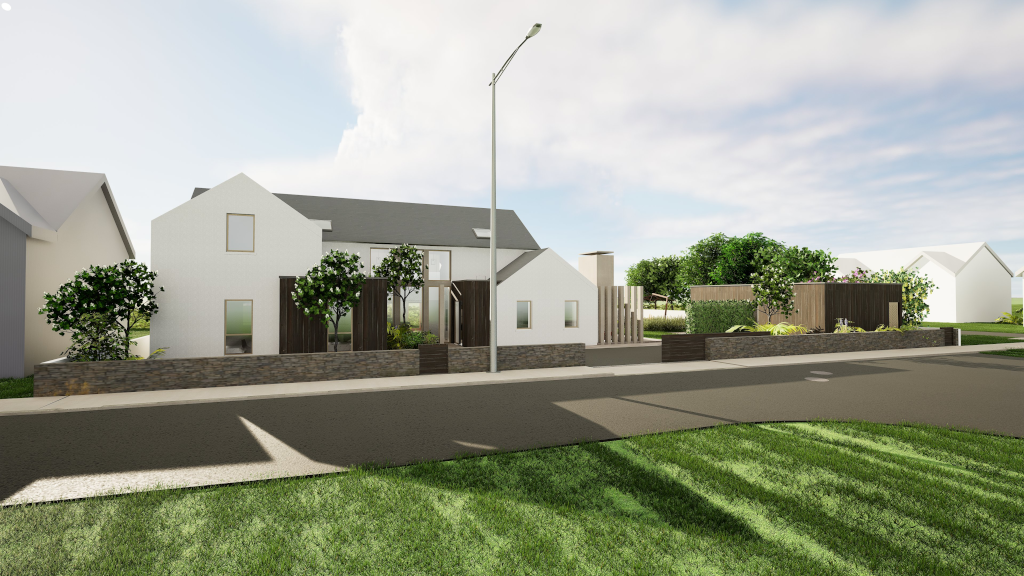
The original from Unreal Engine 5 (but scaled down to 1k from 4k resolution)
I then asked for various renditions, of which these were the best three:
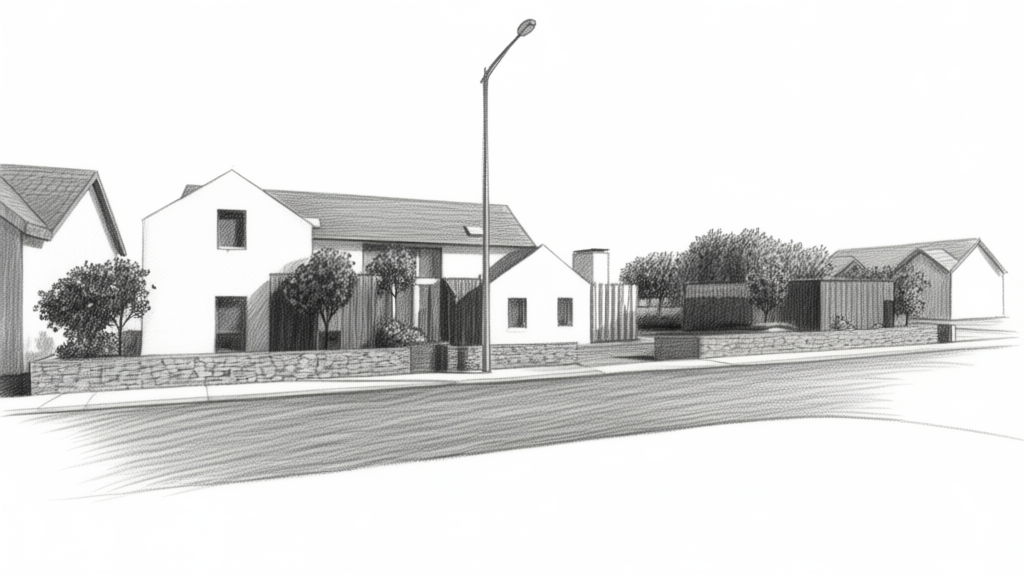
What Qwen3 image edit AI rendered as a charcoal and pencil drawing
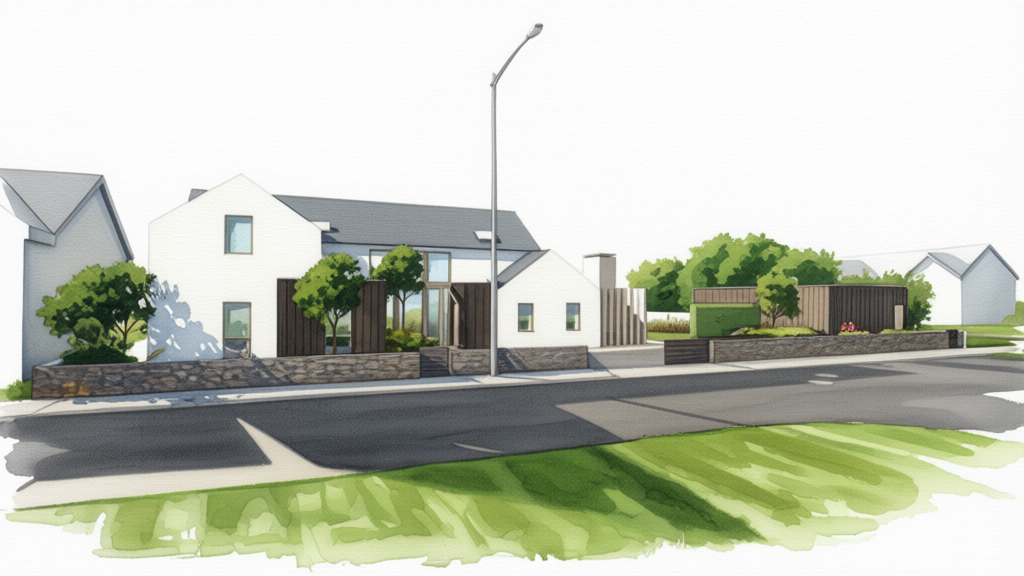
What Qwen3 image edit AI rendered as a watercolour
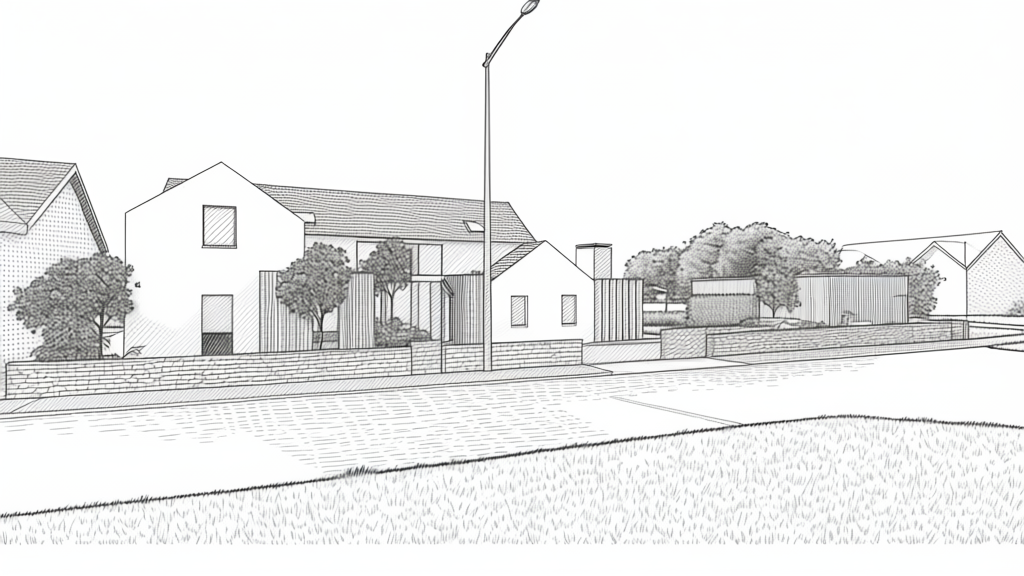
What Qwen3 image edit AI rendered as a finely hatched pencil drawing
This is simple stuff for Qwen3 image edit. It can do a lot more like infer rotation, removal of obstacles in the view (including clothes!), insertion of items, posing of characters, replacing faces or clothing, and it can add and remove text, banners, signs or indeed anything else which you might use in a marketing campaign. All that has much potential for misuse of course – if you want to edit a politician into an embarrassing scene, or a celebrity into your porn scenario of choice, there is absolutely nothing stopping you bar some easy to bypass default filters in Qwen3 image edit.
I thought I’d have it edit the original picture into one of a scene of devastation like after a nearby nuclear strike to see how good it was at being creative. This model is hard on my Macbook, each twenty minute run consumes half the battery as all the GPUs and CPUs burn away at full belt, so this isn’t a wise thing to run when you’re putting the kids to bed. Still, here’s what it came up with for this prompt:
Transform this image into a scene of devastation, with the houses mostly destroyed and partially on fire, the sky dark with smoke and burned out cars and scattered children’s toys on the grass and road.

It looks rather AI generated, but that was genuinely its very first attempt and I didn’t bother refining it to reduce the unrealistically excessive number of burned out cars, the small children it decided to add on its own, or the unphotorealistic colour palette it chose. I don’t doubt that I could have iterated all that away with some time and effort, but ultimately all I was really determining was what it could be capable of, and that’s not half bad for a first attempt for an AI which can run locally on my laptop.
Finally, up until now the best general purpose LLM I’ve found works well on my 18Gb RAM Mac book has been the 8b llama 3.1. It uses little enough memory that 32k token context windows don’t exhaust memory and reduce performance to a crawl, however a potential new contender has appeared which is a per layer quantised 30b Qwen3 instruct model to get it to fit inside 10 Gb of RAM. This model went viral over the tech news last month because it’ll run okay on a 16 Gb RAM Raspberry Pi 5, albeit with a max 2k context window which isn’t as useful as it could be. Thankfully, my Macbook can do rather more, and after some trial and error I got it up to a 20k token context window which is definitely the limit of my RAM (the 18 Gb Macbook Pro has a max 12 Gb of RAM for the GPU).
I should explain quantisation for the uninitiated: models are generally made using sixteen bit floating point weights, and for use reducing those to eight bits halves the RAM consumption and doubles the performance for only a little loss in quality and capability. Below eight bits things get a bit dicier: the four bit quantisation is a common one for retail consumer hardware, there is some loss in the model but it’s usually acceptable. The Mixture of Expert sparse models like those of the Qwen series offer a further option: they work by an initial model choosing which sub-models to use, so you can quantise each of those models individually to pack the overall model more tightly. So your 30b model, which work normally consume 18 Gb of RAM or so at four bit quantisation, can be packed into less if some of the sub-models are quantised down to two bits, but others at four bits, and so on. The aforementional viral model came in a range of quantisations, and I chose the 2.75 bit average quantised model. This fits into 10 Gb of RAM, and this is how it is possible to run a 30b model on a 18 Gb RAM total computer.
I fed both the Qwen3 30b and Llama3.1 8b models the same raw transcribed will of my ancestor Walter Irvine as I fed cloud full fat Claude Sonnet 4.5 a few posts ago, and here are their summaries of that document side by side:
| Cloud full fat Claude Sonnet 4.5 400b? 8 bit? | Local Qwen3 30b 2.75 bit | Local Llama3.1 8b 4 bit |
|---|---|---|
| (nearly instant) | 16k context: 12.54 toks/sec generation 20k context: 6.65 toks/sec (it was swapping to disc) | 16k context: 20.24 toks/sec generation 32k context: 19.47 toks/sec generation |
|
This is a comprehensive probate document from Edinburgh dated November 17, 1825, concerning the estate of Walter Irvine, Esquire, who died on January 7, 1824, at Luddington House, Egham, Surrey. He held properties in the Island of Tobago (West Indies), Luddington House in Surrey, and Denino in Fife, Scotland. Scottish Estate Inventory (Total: £5,258 6s 2d)I. Rents and Arrears Due (£4,569 13s 2½d):
II. Bond from John M. Harlaw of Kirkton: £245 5s 1d plus interest to January 1824 (Total: £262 15s 1½d) III. Bond by Road Trustees (Anstruther-Crail to St. Andrews): £150 principal plus interest (Total: £162 7s 4½d) IV. Bond by Lundenfoot Road Trustees: £50 with compounded interest from 1821-1824 (Total: £55 1s 2d) V. Proceeds from sale of wood: £33 10s VI. Balance due from Walter Dickson WS (Writer to the Signet): £174 16s 11d plus interest (Total: £174 18s 11d) Will Provisions (dated October 18, 1823)Primary Beneficiaries:Wife - Catherine Irvine (née Gordon):
Three Legitimate Daughters (each receiving £35,000):
Natural Daughter - Betsey (of London):
Other Significant Bequests:Ann Stewart (sister-in-law and widow of Stewart):
Brother's Estate:
Nephews:
Nieces (Clara and Marian Irvine - daughters of Christopher William):
Jane Armstrong (formerly Jane Currie, wife of Francis Armstrong):
Mary (reputed daughter of a negro woman named Linda in Tobago):
Other Named Beneficiaries:
Continuing Annuities:
Trust Structure and Powers:Executors and Trustees:
Powers Granted to Trustees:
Specific Provisions for Children's Trusts:
West Indies Property:John Leith Dispute:
Plantation Management:
Scottish Property Requirements:Election Doctrine:
Residuary Estate:After all debts, legacies, and annuities paid, the residue divided equally among three legitimate daughters as tenants in common:
Elizabeth's share for her separate use with power to dispose by deed or will despite coverture. Probate Details:Proved: January 28, 1824, in Prerogative Court of Canterbury Initial Grant of Administration to:
Reserved Power for: John Hamilton, Christopher Irvine, and Thomas Bruce to apply later Witnesses to Will:
Codicil: Dated same day (October 18, 1823), adding £100 bequest to Susannah Ann Hamilton Scottish Confirmation: Presented November 17, 1825, before George Carshin Jr., Commissioner of Edinburgh, with deposition by W.R.K. Douglas confirming the inventory and will details. The document demonstrates extensive wealth with significant properties in Scotland, England, and the West Indies, careful provision for family members including an illegitimate daughter, and sophisticated trust arrangements typical of wealthy estates in the early 19th century. |
The document presents a detailed legal inventory and probate record of the personal estate of Walter Irvine, an Esquire who died on January 7, 1824, at Luddington House in Surrey. The inventory was compiled by William Robert Keith Douglas (a Lord of the Admiralty and Executor), following Walter Irvine’s will dated October 18, 1823, which was proved in the Prerogative Court of Canterbury in 1824. Key Details:
Major Assets & Liabilities (Personal Estate):I. Rents Due to Deceased:
II. Debt to John Harlan:
III. Bond on Road from Auchter and Crail to St. Andrews:
IV. Lundenfoot Road Trusts:
V. Wood Rents Due:
VI. Balance due to Walter Irvine from Walter Dickson (Account Current):
Summary of Estate Value:
Testamentary Will – Key Provisions:Walter Irvine’s will outlines complex trusts and legacies: 1. Annually to Wife Catherine Irvine:
2. Legacies to Children & Relatives:
3. Trusts & Management of Legacies:
4. Additional Bequests:
5. Power of Trustee:
Legal Verification & Probate:
Final Notes:This document confirms Walter Irvine’s death, the validity of his will, and provides a full inventory of his personal estate in Scotland (£5,258.6.2) and English holdings. The complex trust system ensures lasting financial protection for heirs, particularly daughters, with provisions for education, marriage, and inheritance.
|
The text appears to be a combination of two main documents: the last will and testament of Walter Irvine, dated October 18, 1823, and related probate documentation. Last Will and Testament The will is written in a formal style, detailing Walter Irvine's wishes for the distribution of his estate after his death. He appoints five executors to manage his estate: Catherine Irvine (his wife), William Robert Keith Douglas, Alexander Gordon, John Hamilton, and Thomas Bruce. Walter bequeaths various legacies to friends, family members, and charities. These include:
He also establishes a trust for his daughters Elizabeth Douglas, Christina Charles, Catherine Grace, and Betsy. Each daughter will receive one-third of the estate upon their marriage or death. The surviving husband will have a life interest in the legacy after his wife's death. Walter also directs that his real and personal property be held in trust for his three daughters (or any of them who survive him) to be divided equally between them as tenants in common with benefit of survivorship. He also provides for the education, maintenance, and advancement of each daughter's children. Probate Documentation The will was proved on January 28, 1824, in the Prerogative Court of Canterbury, where Catherine Irvine and William Robert Keith Douglas were sworn as executors. On November 12, 1825, Lord Wm K K Douglas (presumably a judge) granted probate to the executors. This grant refers back to Walter's deposition on the inventory of his personal estate on October 25, 1825. The probate documentation includes various affidavits from witnesses who attest that Walter Irvine was of sound mind and disposing memory when he made his will. The will is described as being written in eighteen sheets of paper with a seal attached to the final sheet. Inventory of Personal Estate An inventory of Walter's personal estate was prepared by Mr. Walter Dickson, Winter (a Signet). It lists various debts owed to the deceased, including:
The total value of Walter's estate in Scotland is estimated to be £5,258.6.2. Overall, the text provides a detailed picture of Walter Irvine's last will and testament, as well as related probate documentation and an inventory of his personal estate. |
Scroll down to see more ...
Unsurprisingly, the 400b? full fat Claude Sonnet 4.5 model does by far the best summary. The Qwen3 30b model is obviously a lot more detailed than the Llama3.1 8b model, but it also misbalances what detail to report upon and what to leave out e.g. it gets what was left to Betsey completely wrong. Llama3.1 8b produces a short summary consisting of only what it thinks are the bare essentials, and I would personally say it’s a fairly balanced summary choosing a fair set of things to report in detail and what to omit.
After a fair bit of testing, I think I’ll be sticking to Llama3.1 8b for my local LLM use. It has reasonable output, it follows your prompt instructions more exactly, and it’s a lot faster than the Qwen3 model on my limited RAM hardware. But Qwen3 did better in my testing than anything I’ve tested since Llama3.1 came out – I was not impressed by Gemini 12b, for example, which I found obviously worse for the tasks I was giving it. Qwen3 isn’t obviously worse, it looked better initially, but only after a fair bit of pounding did its lack of balance relative to Llama3.1 become apparent.
All that said, AI technology is clearly marching forwards, give it a year and I would not be surprised to see Llama3.1 (which is getting quite old now) superceded.
Returning to ‘what’s coming next?’, I shall be taking my children to England to visit their godparents in April which will give Megan uninterrupted free time to study. I expect that will be my only foreign trip this year. During February and March I mainly expect to clear all open bugs remaining in my open source libraries, practising more with AI tooling, and keep clearing items off the long term todo list. I am very sure that I shall be busy!
| Go to previous entry | Go to next entry | Go back to the archive index | Go back to the latest entries |