Word count: 3807. Estimated reading time: 18 minutes.
- Summary:
- A house build is described, alongside a need for temporary accommodation due to eviction. Mobile homes are analysed, with brands like Willerby, ABI, and Swift compared. Insulation levels and residential specifications are evaluated. A plan for a hardstanding area is detailed. Finally, the depreciation of mobile homes and the progress of an AI project are mentioned.
Tuesday 15 September 2026: 11:43.
- Summary:
- A house build is described, alongside a need for temporary accommodation due to eviction. Mobile homes are analysed, with brands like Willerby, ABI, and Swift compared. Insulation levels and residential specifications are evaluated. A plan for a hardstanding area is detailed. Finally, the depreciation of mobile homes and the progress of an AI project are mentioned.
- Foundations should start to be installed end of this month.
- Timber frames should be installed early February.
- We received notice of eviction from our rented house today, and we have to out by March.
Obviously the house won’t be ready to move into by March, so we need somewhere to live for a few months to bridge the gap. As landlords don’t look kindly on renting out to those without income, and given the current Irish rental market, I would expect our chances of finding a new rental to be approximately nil. One could rent a holiday home from the likes of AirBnB, but that would get real expensive over the summer, and money isn’t exactly growing on trees right now. So we probably have no choice: we’ll need to live in a mobile home (aka ‘static caravan’) for a while.
Ugh, mobile homes
I’ll start by saying I absolutely hate camping, and a close second behind my hatred of camping is caravans and then mobile homes. Back in July 2021 when covid was raging and there were no vaccines, we rented a campervan to get to and from Megan’s brother’s wedding in England without risking catching covid, and thinking about those three weeks still gives me the shudders – I remember myself and Megan definitely had PTSD for days after our return, though the kids loved it. Those awful contraptions are either too hot or too cold, they are always damp so I can’t sleep, and they always smell bad. They’re uncomfortable, cramped, and exactly the last thing I’d want to endure during a holiday. So, given my hatred of all things camping related, I have never had the slightest interest in mobile home nor caravans other than a vague awareness that a ‘Pemberton’ was a slightly less awful brand for twice the price of a normal mobile home.
Obviously now I need learn about them in quite some detail so I have some idea what to look for and what tradeoffs to make in terms of age to features to price. But firstly, here is where I intend to place the mobile home on the site:
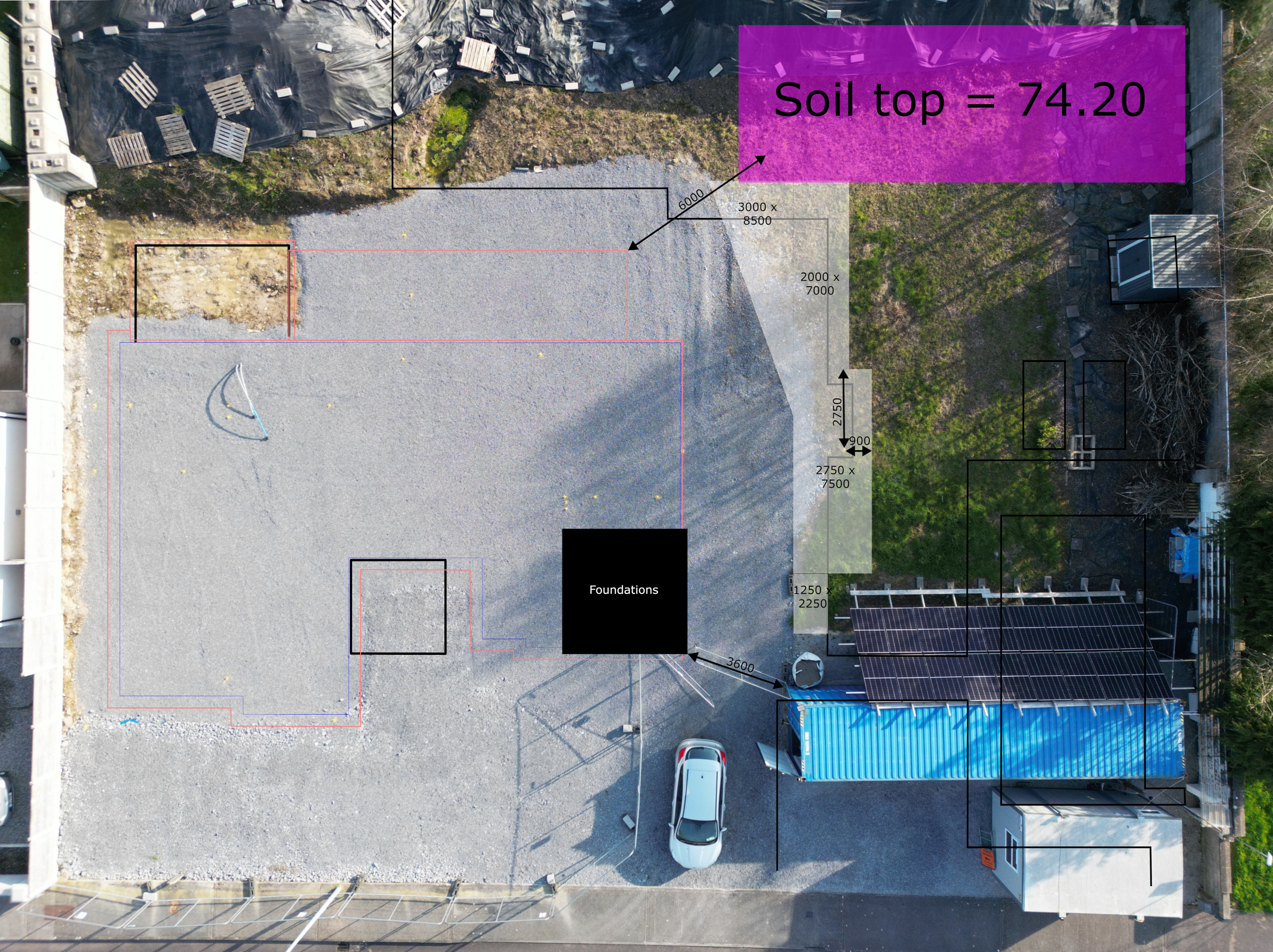
We were going to be extending the hardstanding in any case where the white shaded patches are to permit low loader trucks turning access next to the house – we were prevented because right now there is a giant soil pile there which still hasn’t been taken away despite me ringing them weekly. That same extended hardstanding happens to be where the patio will go in any case, so we’re just doing it early. We have a 3.6m wide gap between the house corner and the shipping container, and as lorries can be a maximum of 3.0m wide they can get past with a bit of careful driving.
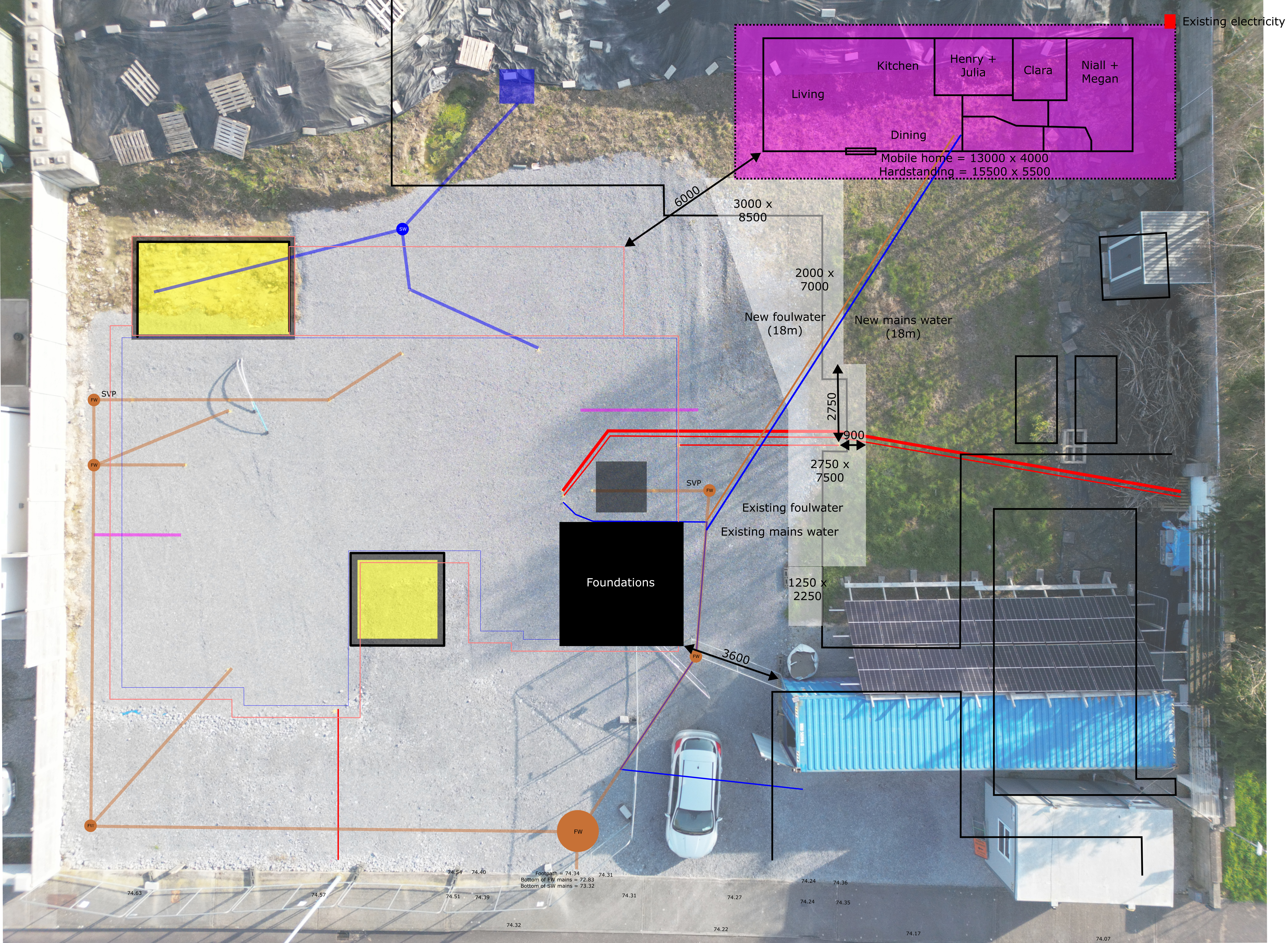
My plan is to dig a shallow 250 mm deep hole where the pink shaded patch is – this is 15.5m wide and 5.5m tall, which should accommodate a mobile home sized 11.8m long and 3.76m wide with a 1.5m wide hardstanding at the front. That is 21.3 m3 of volume, so about 42 tonnes of crushed rock, which is two eighteen tonne truck loads probably of four inch down laid 100 mm thick each layer, with six tonnes of two inch down or two inch clean finishing layer making up the top 37 mm. By being right next to the rear walls, hopefully the prevailing south west wind will mostly flow over the mobile home, reducing forced air changes per hour. There should be a 6m gap between the mobile home and the foundations at their closest point, easily enough for cranes etc to pass.
We have existing electricity right next to that location, and foulwater and mains water would only need a spur about 18m long to be added. That’s well within my own personal capabilities, so I’d just rent a digger and do it myself:
You get about 40 m2 of floor space in a three bedroom 12 ft wide mobile home. It’s not a lot, however after February 2027 will we have at our disposal 250 m2 of indoor space in the house being constructed, plus the office portable cabin remains available. Our current rented house has about 55 m2 of floor space, so the mobile home will be equivalent to losing our front downstairs room which I currently use as my work office (and is mostly filled with storage in fact). And if we get a mobile home with an equivalent insulation level to this rented house, the adjustment may not be as awful as it first seems – we’ve effectively already been living in a mobile home until now.
What we will need is temporary storage as the shipping container at the site is full. Thankfully, North Cork has some of the cheapest self storage in the country: about €6 inc VAT per month per m3 of shipping container storage. Once the house is up and secure, we can move everything out of self storage into the house.
Detangling mobile homes
I’ve learned far more about mobile homes than I ever wanted to in the last few days, so first fun fact about them: a shockingly large percentage of the total British/Irish stock are made in and around Hull, Yorkshire, where I once used to live. I had no idea if I’m honest: there is a genuine cluster of manufacturing around the East Yorkshire region, and the three most popular brands by volume are all made there, along with several of the small upstarts which are startups created by former employees of the big manufacturers. Over in Europe mobile homes and caravans are quite different to the British ones, over there they tend to build things to last with an accompanying high initial purchase price, whereas in Britain/Ireland they are built to a cheap standard and build quality is more uneven – however they are much cheaper as a result.
Speaking of which, here are the top brands by market share, and my single line summary of each:
- 33% Willerby – ‘nobody ever got fired for buying a Willerby’.
- 13% ABI – slightly better bang for the buck over a Willerby.
- 10% Swift – slightly better bang for the buck over an ABI and slightly more again over a Willerby.
- 8% Carnaby – budget choice for those who can’t afford a Willerby.
- 36% Others (in order: BK Bluebird, Cosalt, Pemberton, Delta, Victory)
At least in the British/Irish market, everything is defined by Willerby, and everybody else measures themselves against Willerby. Willerby, being large and conservative and the biggest, moves slowly and conservatively, but they set the pace and pricing for the rest of the market. They probably also have one of the best after sales support, from what I can tell, followed by Swift where there are more reports of build quality issues but after sales seems good at getting them fixed, then quite a large gap to ABI where after sales appears to be poor, with Carnaby at the bottom with essentially no after sales support at all and you’re on your own to fix any build quality issues – on the other hand, you have saved €8-12k and that’s why your mobile home is so cheap.
It turns out that almost nobody tells you specifications or build details, and the brochures are almost entirely pictures of the insides with soothing words about how great the product looks. Willerby is easily the worst on this: they won’t even tell you the exterior dimensions apart from a general ‘this is the largest footprint’, or what insulation is fitted other than ‘twice as much as the previous model’ which is nearly useless. Swift is probably the market leader on detail, you get exact dimensions inside and outside, and also exactly how much insulation is fitted to walls, the floor and roof. They also – uniquely – provide free to download every owner’s manual by year going back to 2001, and from those I was able to build a timeline of what specs each year of Swift mobile home has. Which is exactly what they all should do, to be honest.
Why they don’t is because mobile home sales are an unusual business. Most sales go to caravan parks who then resell them on to clients or they rent them out. Clients who buy them face steep annual ground rental fees of about €3k per year excluding bills and insurance, plus you are generally required to remove your mobile home from the park once it is twenty, fifteen or even ten years old, depending on the ‘fanciness’ of each mobile home park. Of course there is a fee for that, and there is a further fee for bringing in your own mobile home. To be honest, I personally would run a mile from any of those arrangements – even if you live in your mobile home three months of the year, the sums just really don’t add up with such steep depreciation and cost overheads. You’d be far better off buying an apartment, and at least that would hold its value and might even appreciate. In any case, because the real customer is caravan parks, and they care about profits rather than specifications, there is little incentive for manufacturers to publish or make available detail about what you are buying.
All that just said, I have reverse engineered some specifications and detail about the big three mobile home brands. I left out Carnaby because it’s rare they are fitted with the optional insulation upgrade, however they’re also transparent: the standard 2025 model has 25 mm wall insulation, and the ‘ultra warm’ upgrade increases that to 50 mm. Until recently, they fit no insulation at all as standard, they were the last to start fitting some out of the major brands. The second last is actually none other than Willerby …
Willerby mobile homes
The cheapest three bed Willerby, the Rio, costs €59k new in Ireland and probably has 30 mm of wall insulation (I can find absolutely no data online on what floor or roof insulation is fitted, other than there is some on both). From September 2022 onwards Willerby have been banging on about their ‘GreEN standard’ which is supposedly way higher insulation. In fact, it’s almost entirely marketing fluff:
- 2020-2021: 3.982 wide incl gutters (0 mm insulation per wall?)
- 2022: 4.020 wide incl gutters (9 mm insulation per wall?)
- 2023-2024: 4.042 wide incl gutters (20 mm insulation per wall?)
- 2025-2026: 4.062 wide incl gutters (30 mm insulation per wall?)
I’m purely guessing here by stated width including gutters which is the only datapoint I have, and also their marketing claims about ‘double thickness wall insulation’ and ‘28% energy efficiency improvement’ where I assume that they don’t lie. So while yes while 2022 added insulation for the first time, and yes from 2023 onwards they had double the insulation AND a vapour control membrane, from 2025 onwards they also silently increased the insulation by 50%.
Conclusion: Don’t buy a used Willerby before 2023 (three years old), not worth it. A 2023 Willerby costs about €50k right now, and it has less than half the insulation of an ABI after 2020. Willerby before 2023 are considerably cheaper.
ABI mobile homes
The cheapest three bed ABI, the Beverley, costs €65k new in Ireland. The extra 10% price bump does get you some nice things however: galvanised chassis (an optional extra for the Willerby), 50 mm wall insulation, 100 mm roof insulation, and an unknown amount of floor insulation. Their history over time:
- 2015: 3.68 wide (3.95 incl gutters). 100mm roof insulation, no floor insulation, unsure wall insulation.
- 2020: 3.68 wide (3.95 incl gutters). Brochure claims 50 mm on all model’s walls except the Coworth and Rydale, and 100 mm roof insulation on all models.
- 2022-2025: High end is 3.74 wide (4.01 incl gutters); low end is 3.68 wide (3.95 incl gutters). Brochure claims 50 mm on all model’s walls except the Coworth, and 100 mm roof insulation on all models.
The reason I can’t give you detail between the years is I couldn’t find brochures nor catalogues except for the years 2015, 2020, and 2022.
Conclusion: Don’t buy a used ABI before 2020 (six years old), not worth it. A 2020 ABI with Winter Pack costs about €40k right now.
(A ‘Winter Pack’ simply means it has double glazed windows and central heating which usually takes it into EN1647 Grade Three – see below)
Swift mobile homes
Swift like ABI tend to rotate in new models in over time, and carry on selling the old models for a period as the lower end models. Their current new models are the Burgundy, Morlaix and Margaux, and all three have galvanised chassis’, 60 mm of wall insulation, 100 mm of roof insulation, and 80 mm of floor insulation. As I mentioned above, Swift publicise exact numbers for all their models AND provide all the documentation going back decades, so I can make this high fidelity history over time:
- 2005-2015: 3.66 wide (10 mm insulation per wall). Same as a 1950s Irish house, about BER G rating.
- 2016-2024: 3.70 wide (30 mm insulation per wall). Same as a 1980s Irish house, about BER D rating.
- 2025-2026: 3.76 wide (60 mm insulation per wall, but only Burgundy, Morlaix and Margaux), 80 mm in floor, 100 mm in roof. Same as a 1995-2005 Irish house which was BS3632 residential spec 1995-2005, about BER C rating.
Current prices for a new latest generation three bed Swift:
- €61k: Burgundy
- €66k: Morlaix
- €68k: Margaux. This one is unusual in that I don’t find its insides hideous like any mobile home I’ve been in. It actually kinda looks pretty good.
Conclusion: Don’t buy a used Swift before 2016 (ten years old), not worth it. A 2016 Swift with Winter Pack costs about €35k right now. Slightly older Swifts are much cheaper.
All brands – the BS3632 residential spec
Leisure mobile homes meet the EN1647 standard. This has grades one, two and three:
- Total building fabric must have a u-value <= 1.7 W/m2K.
- Total building fabric must have a u-value <= 1.7 W/m2K and outer pipes lagged.
- Total building fabric must have a u-value <= 1.2 W/m2K and outer pipes lagged.
My future house has a total building fabric u-value of 0.18 W/m2K I believe – the maximum permitted by Passive House is 0.20 W/m2K. So obviously a leisure mobile home will be rather less energy efficient 😊.
Everybody says if you want to live in a mobile home over the winter, you need to get a residential spec edition – this raises the insulation and thermal bridging up to the same as a minimum build standard house in Britain, which is the BS3632 standard. Britain used to raise its minimum build standards in lockstep with Ireland until Brexit in 2020, after which they diverged:
- 1989-1994: walls u-value <= 1.0 W/m2K, floor u-value <= 1.0 W/m2K, roof u-value <= 0.60 W/m2K.
- 1995-2004: walls u-value <= 0.60 W/m2K, floor u-value <= 0.60 W/m2K, roof u-value <= 0.35 W/m2K. About Irish BER C.
- 2005-2014: walls u-value <= 0.50 W/m2K, floor u-value <= 0.50 W/m2K, roof u-value <= 0.30 W/m2K. Walls same as pumped cavity block wall.
- 2015-2022: walls u-value <= 0.35 W/m2K, floor u-value <= 0.35 W/m2K, roof u-value <= 0.20 W/m2K. About Irish BER B.
- 2023-2026: walls u-value <= 0.30 W/m2K, floor u-value <= 0.26 W/m2K, roof u-value <= 0.20 W/m2K.
Now, you can kinda map the mobile home specs above to BS3632 as follows:
- 30 mm of XPS would have a u-value of 1.1 W/m2K.
- 60 mm of XPS would have a u-value of 0.55 W/m2K.
- 80 mm of fiberglass wool would have a u-value of 0.55 W/m2K.
- 100 mm of fibreglass wool would have a u-value of 0.44 W/m2K.
Obviously walls/floors/roofs would be a bit better than just the raw insulation, but we are also ignoring thermal bridging and ventilation, so based on that taking a 2026 Swift mobile home with leisure spec we can see it is approximately the same as BS3632 residential spec between 1995 and 2004 – quite a bit worse for the roof, a bit better for the walls and floor. Which means a residential spec mobile home aged between twenty-two and thirty-one years old would be approximately equivalent to a brand new leisure spec Swift mobile home.
As mobile home parks force out fifteen to twenty year old mobile homes no matter their condition, there is a comparative surfeit of them, and they’re cheap enough e.g. a year 2004 residential spec Swift Moselle is currently on DoneDeal for €23k, and a 2010-2014 model can be had from the ‘Mobile homes all Ireland’ Facebook group for €26k. The problem with twenty year old mobile homes is you’re always going to be worried about structural rot or older appliances breaking down and I’m not at all sure how well I’ll be able to tell from inspection what works or not, or whether water ingresses when it rains etc. That said, I have seen residential spec mobile homes as recent as 2019 with a one year warranty from a main dealer for €32k. Still, as this is the cheapest bang for the buck, it is the most likely choice we’ll end up with.
Assuming of course that a decent one turns up on the second hand market after I have the hardstanding for it done. One advantage of buying new is you’re guaranteed it’ll be available and on your site by a certain date. If buying used, it’s far more luck of the draw.
Conclusion: A more than twenty year old residential spec mobile home is worth considering if and only if (a) it is in great condition and (b) it’s cheap enough. It is probably worth seeking one with a warranty from a main dealer, then at least somebody has tested the boiler and done a deep clean.
Depreciation and resale
As I alluded to above, mobile homes have steep depreciation curves – about the same as a car. You lose about one third of the value after three years, thereafter depreciation slows and they are usually worth about 50% of the current new price at ten years old. After fifteen years old because many mobile home parks force their sale, the lower spec ones tend to be plentiful and they take a fair price drop, and then because all mobile home parks force their sale after twenty years you get residential spec models aplenty. After fifteen years for leisure spec, and after twenty years for residential spec, they are generally worth 15-20% of the current new price. Some of that is because they can no longer be mounted in mobile home parks, so there are more sellers than buyers, and the price drops accordingly.
Who then buys all these old ex-park mobile homes? Given how quickly they clear from DoneDeal (an Irish online marketplace), it would seem there is a large market of families in exactly our situation: in the middle of building their house when they got evicted. So long, therefore, that the self building house building section of society remains strong then you should be able to sell any mobile home you purchase. And even if there were a hefty economic downturn, there would be a period where rents remain high and people get evicted and need somewhere to live. Only after rents had fallen due to lack of occupancy might the market for used mobile homes dry up.
All this stands in contrast to modular homes, which have become very popular in Ireland since a planning rule change this summer. These are generally wider than mobile homes and made from a steel frame rather than a timber frame, and they tend to be better insulated. They also arrive on the back of a truck and are craned into position. As they are wider, transporting them will be more expensive and relocating them after sale may be harder. There is also no existing data on what their depreciation rate will be, nor whether there will be a second hand market for them at all. I think therefore that these are probably best avoided for now unless you want to risk never being able to get rid of it in the future.
What’s next?
I think where we are at is probably we ideally want a residential spec mobile home manufactured after year 2005 (so max twenty-one years old), then you’re within the 2005-2014 BS3632 residential spec bracket. If you want it with a main dealer warranty i.e. somebody knowledgeable has checked it for leaks and broken appliances and is willing to stand over it, you’re probably talking €30-40k with a likely resale value of €20k on the used market after.
Assuming an eighteen month period to live in it, that is equivalent to a monthly rental of €833. If a twelve month period, then €1,250. Quite a bit more than we currently pay to rent this home (which is why we’ve remained here so long), but still way lower than any property currently being rented out anew.
Obviously this bombshell will rather upset my original plans for getting stuff done this Autumn. Most unfortunate. I now need to pack everything up in the rented house and move as much of its contents out into storage as possible, and that will take weeks to months and all that is time not spent doing what I had intended to do. Still, we were going to have to move out eventually in any case, so this is future work moved up to earlier than expected.
Speaking of said original plans … my custom AI harness is now dogfooding itself, so it now iterates rounds of review and fix upon itself and we are getting ever closer to something which has all its warts and corner cases ironed out. This has taken longer than expected: it fairness, only by dogfooding itself did we discover various architectural design mistakes and then when you change a bit of the architecture, that produces ripples which takes a while to tamp back down again. But we’re definitely into the last 5% of work on it. Then I intend to set it loose on multiple other projects, as now I’ll be safe in the knowledge it can be left run unattended and I no longer need to hover over it. That means I can get to bed earlier as I currently have to hover over it until 2 am each night as that’s when the peak rate time begins, then I set it running again at 11 am each morning as that’s when the peak rate time ends. Very much looking forward to not having to do that anymore.
| Go to previous entry | Go to next entry | Go back to the archive index | Go back to the latest entries |