Word count: 2666. Estimated reading time: 13 minutes.
- Summary:
- The as built survey is documented. A boundary wall was painted, and a water intrusion issue in the pool cavity was encountered during testing. Furthermore, reference levels were remounted, and the as-built survey data was compiled following the completion of groundworks.
Thursday 23 July 2026: 20:29.
- Summary:
- The as built survey is documented. A boundary wall was painted, and a water intrusion issue in the pool cavity was encountered during testing. Furthermore, reference levels were remounted, and the as-built survey data was compiled following the completion of groundworks.
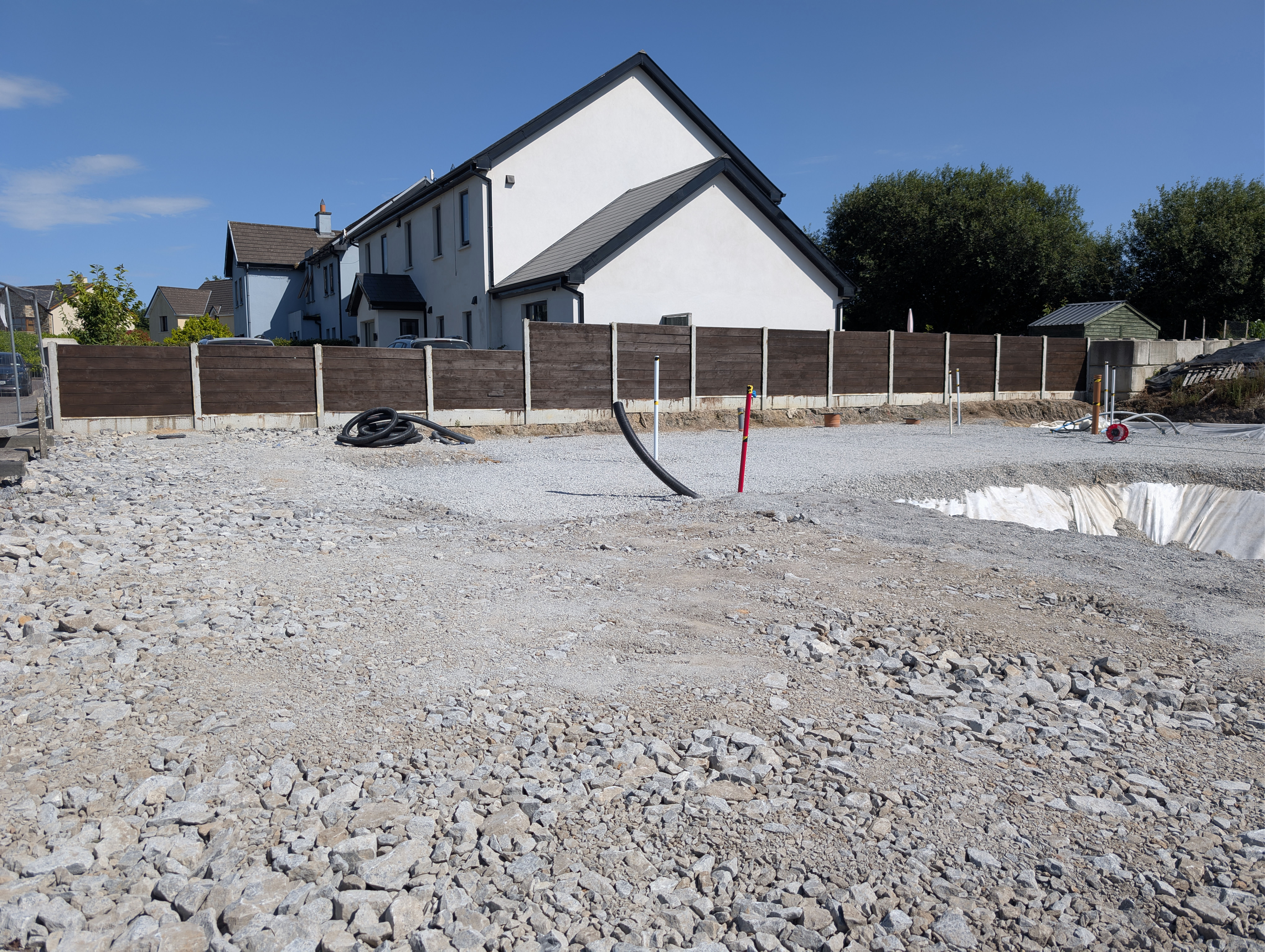
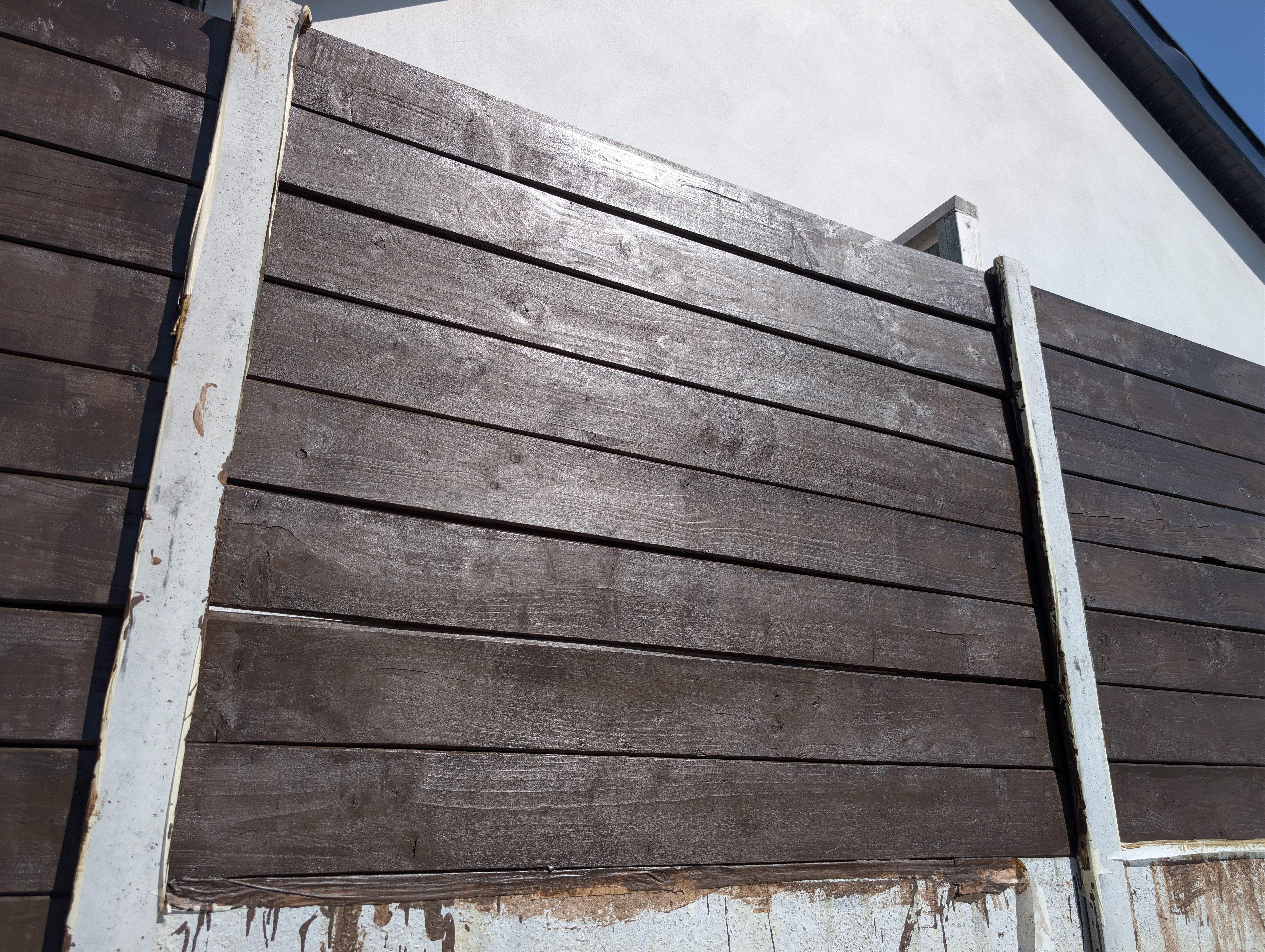
That ended up being four coats of cheap stain and one coat of expensive stain: we probably should have applied a fifth coat of cheap stain to reduce the blotchiness by a bit more, but we were out of time as camps began the next day so I just had to draw a line under it. It is my no means bad, just not as evenly coloured as I would personally prefer. Clara and Henry did well, it was their first time painting anything big and given the hot weather, staying the course required will power. My son, aged nine, clearly was very done with painting by the end of the fifth day of it, but then he is aged nine. Both did good quality work, I only had minor touch ups to do and those were principally due to their lack of experience painting a wall. Total all in cost including paying them €150 between them was €300 inc VAT for twenty-four metres of wall, or €6.25 per sqm. That’s very good in my opinion for painting an unpainted wall which tends to soak up the paint first time.
The pool cavity becomes a pool!
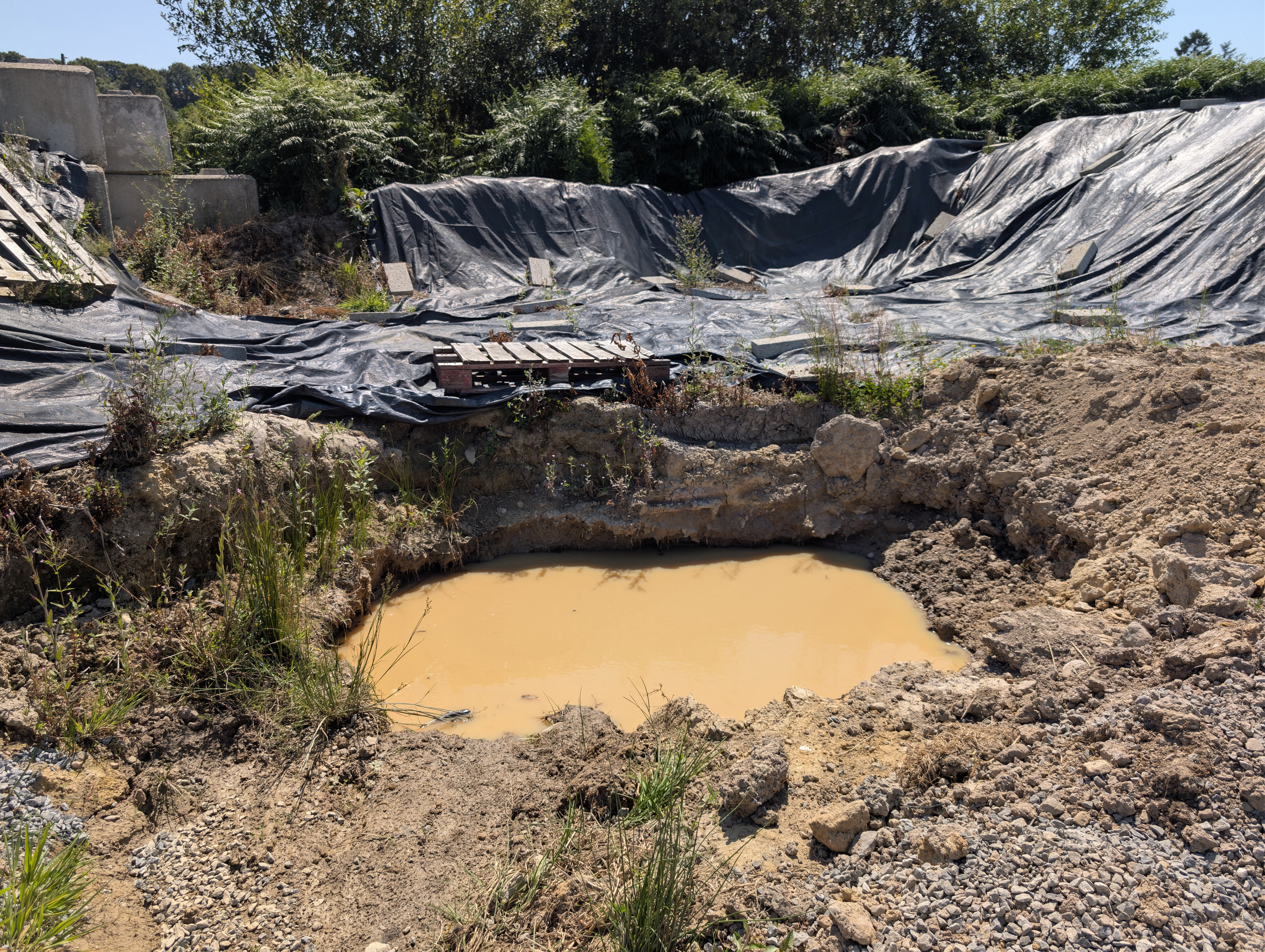
An unpleasant surprise turned up part way through the left wall staining: the pool cavity became a pool! Here it is with the water already mostly pumped out:
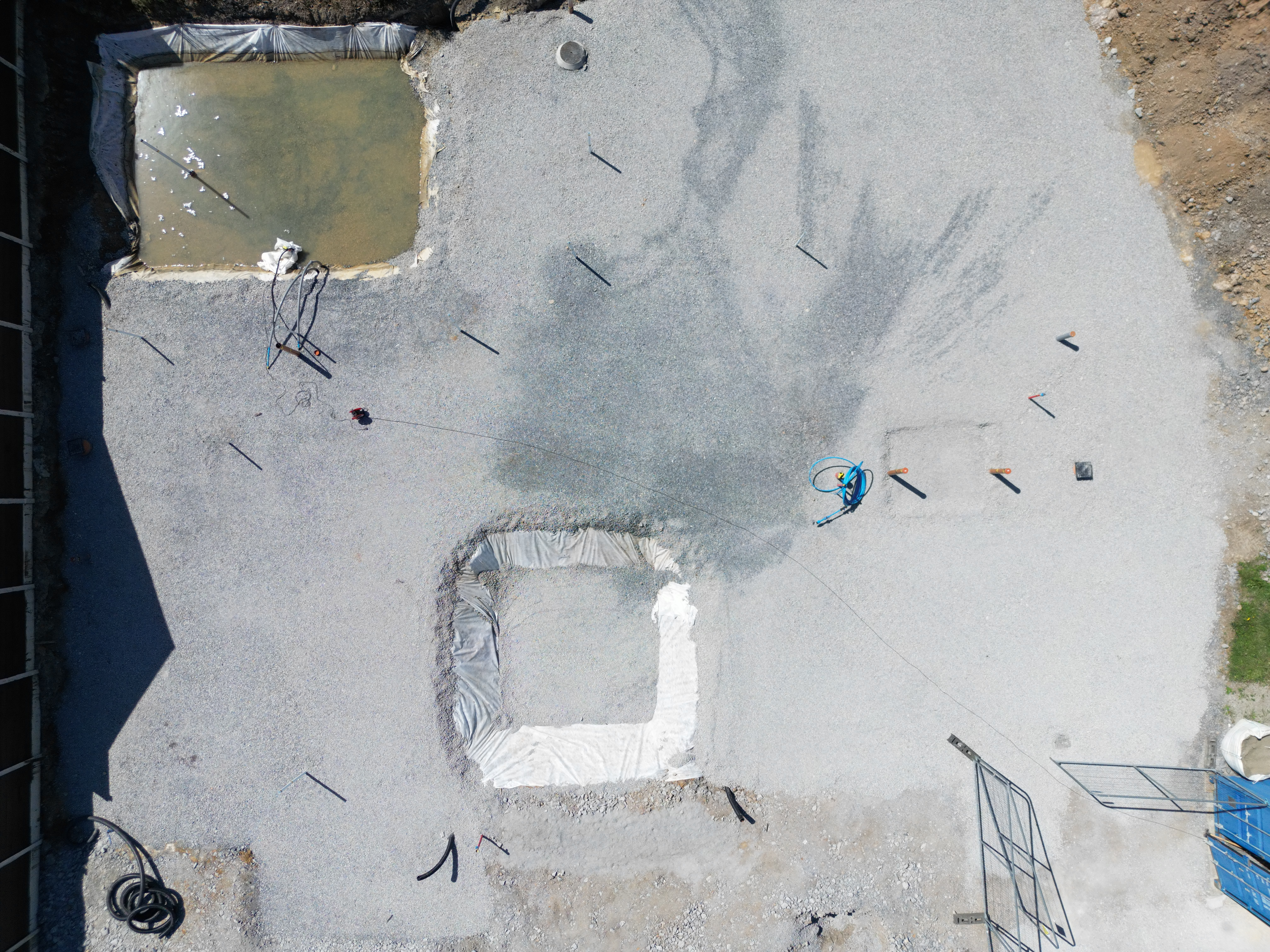
The water I reckon was about 400 mm deep if you include the stone layer at the bottom, and about 330 mm deep from the top of stone within that pool cavity. Very obviously, the tree cavity – which is much deeper – was dry as a bone, and it has not rained to any extent in weeks. So it is a mystery how it filled up like that!
I took the opportunity to use the water to test my percolation test hole. While we were digging out the pool cavity, we found at the bottom some possibly wet soil whereas the tree cavity was dry as a bone all the way down. That got me curious, so I had the groundworks guys dig me as deep a hole as the digger would go right next to the pool cavity where the future soakaway was planned to get installed:
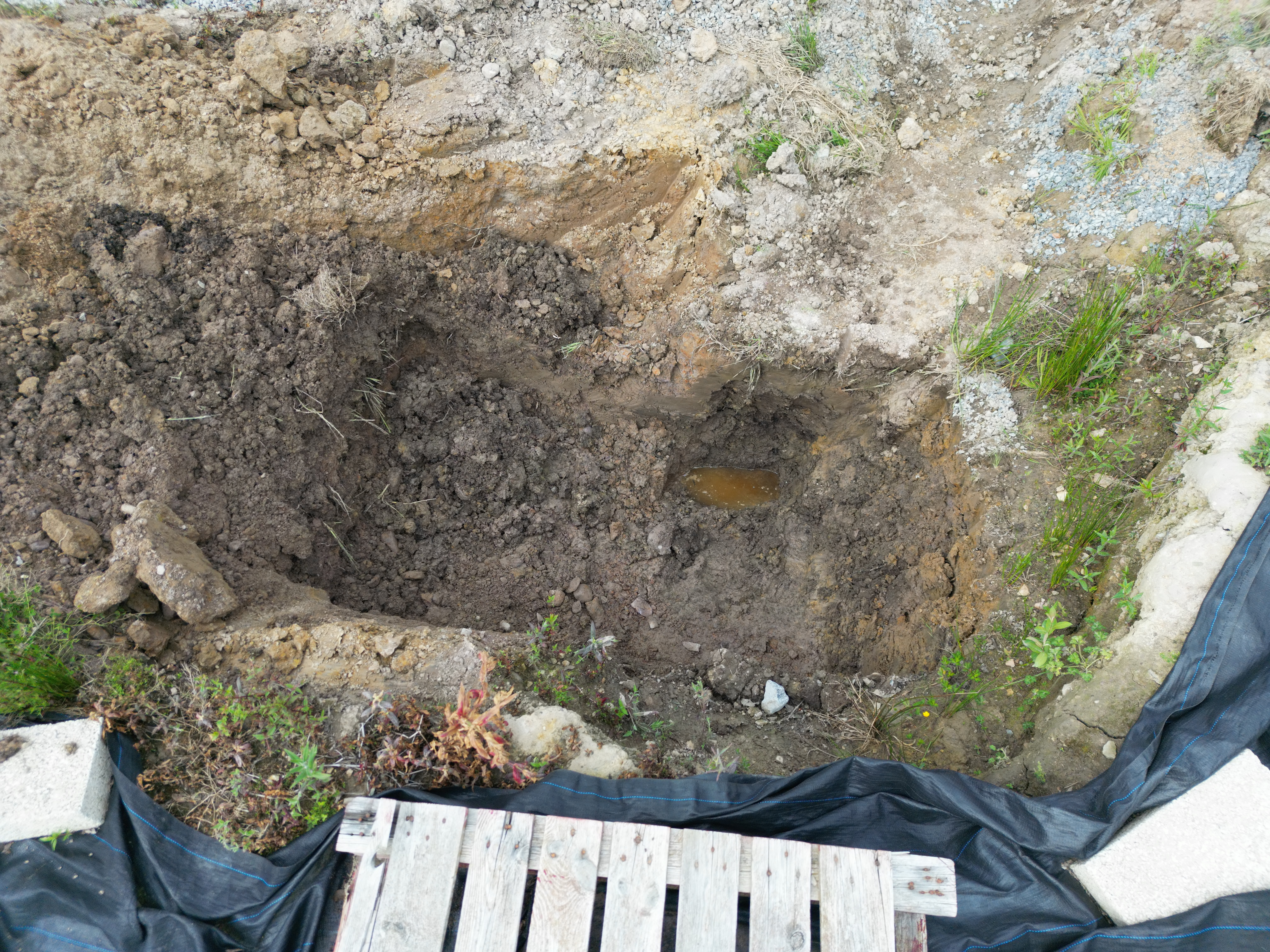
That’s about 1.6 metres deep, and you can see a little bit of ground water down there, so obviously the water table is somewhat high around here. My concern was that installing a soakaway two metres down would be pointless if it was below the water table in summer, and I can confirm that that little bit of water didn’t budge in the days after it was dug. When the pool cavity filled up, it still didn’t budge after several days, so I wondered what if I filled that percolation test hole and emptied the pool cavity. Here is the result after five days:
It may have dropped by an inch in five days during ~28 C constant sunshine weather, so I’m going to claim that the height loss was entirely evaporation. The pool cavity remained bone dry after it was pumped out, and as the top of water in the percolation hole is about half a metre above the bottom of the pool cavity, so clearly my subsoil has almost zero percolation. This was another unpleasant surprise, as I had specifically chosen this site expecting subsurface static water pressure to cause flow over my subsoil heat exchanger into the ditch just behind my property, making the heat exchanger more efficient. Apparently I have here the exact opposite 🙁.
My current working theory is that my neighbour may have doused his garden with water to keep it alive, and due to the lack of percolation all that water promptly poured through his upper layer of topsoil over his subsoil into the pool cavity. If this is the case – I shall be watching things carefully – then there is a danger that the RC box going into the pool cavity could float if enough water surrounds it. To calculate that:
Pool cavity including EPS: 5885 x 3730.
EPS thickness: 200, with density 40 kg/m3.
RC thickness: 200 at bottom 215 at sides, with density 2,500 kg/m3.
Empty middle: 5055 x 2900, with density 1.25 kg/m3 (air).
So:
- Total horizontal area = 21.95 m2.
- Horizontal area of RC box = 18.27 m2.
- Horizontal area of empty air within RC box = 14.66 m2.
- Horizontal area of RC box = 18.27 m2.
- Bottommost 200 mm of EPS = 4.39 m3 => 175.60 kg.
- Nextmost 200 mm of RC box = 3.65 m3 => 9,133 kg plus 30 kg for the outer EPS => 9,163 kg.
- Remaining H metres of RC box = H x (40 x (21.95 - 18.27) + 2500 x (18.27 - 14.66) + 1.25 x 14.66)
- H x (40 x 0.736 + 2500 x 3.61 + 1.25 x 14.66)
- H x (29.44 + 9025 + 18.33)
- => H x 9073 kg.
Therefore:
H x 2195 (water) = -(9339 + (H - 0.4) x 9073) (RC tank)
H = ~0.51 metres above the base of the RC box
As the pool cavity is 0.77 metres below the top of T2 stone, and the T2 stone is about 200-250 mm deep, any water entering the pool cavity should overflow under the rest of the house before the RC tank would float, so we’re safe.
That said: you better believe I’ll be running the land drain out of the pool cavity no higher than 0.5 metres from its bottom, just in case.
Remounted the reference levels
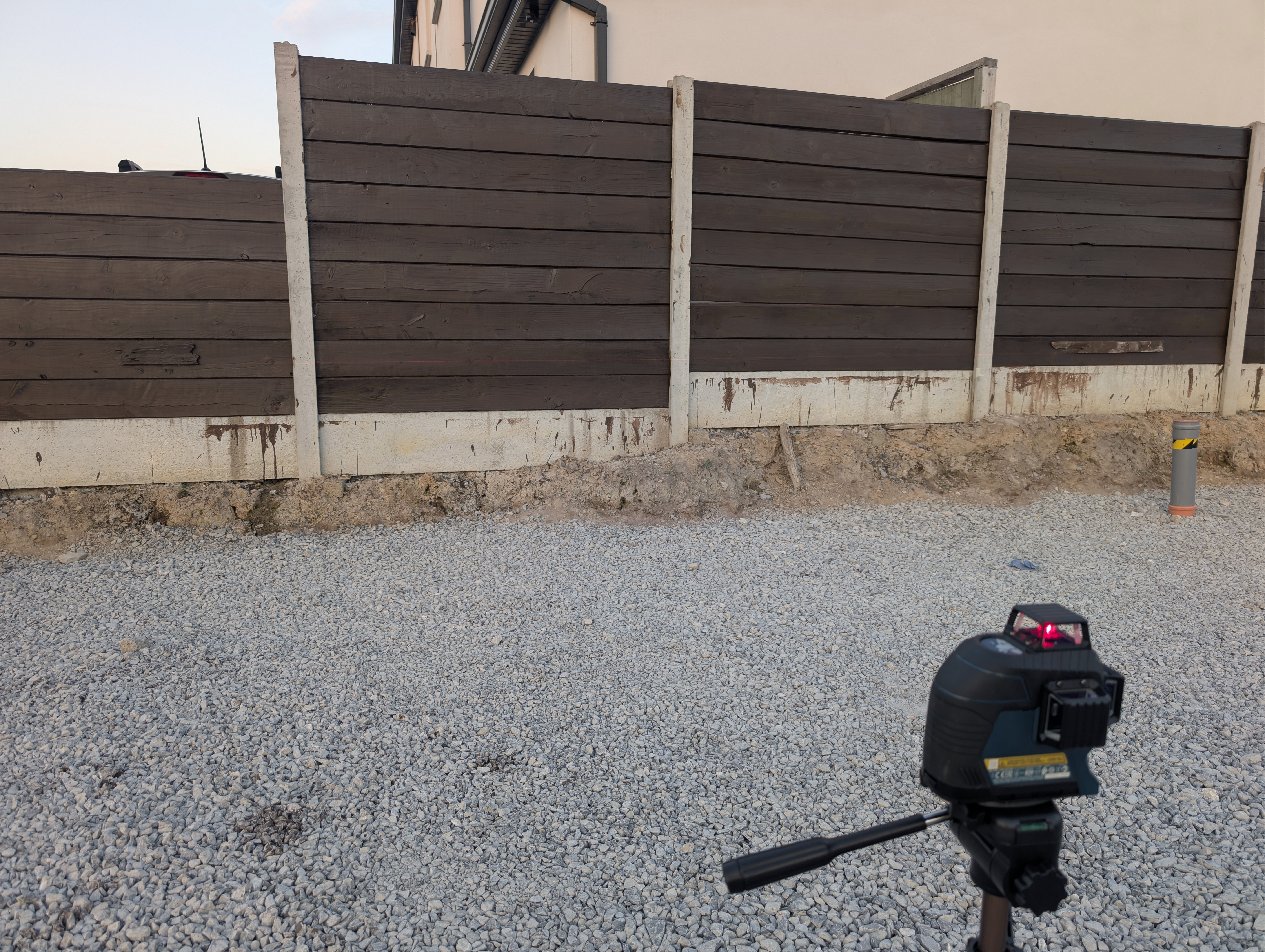
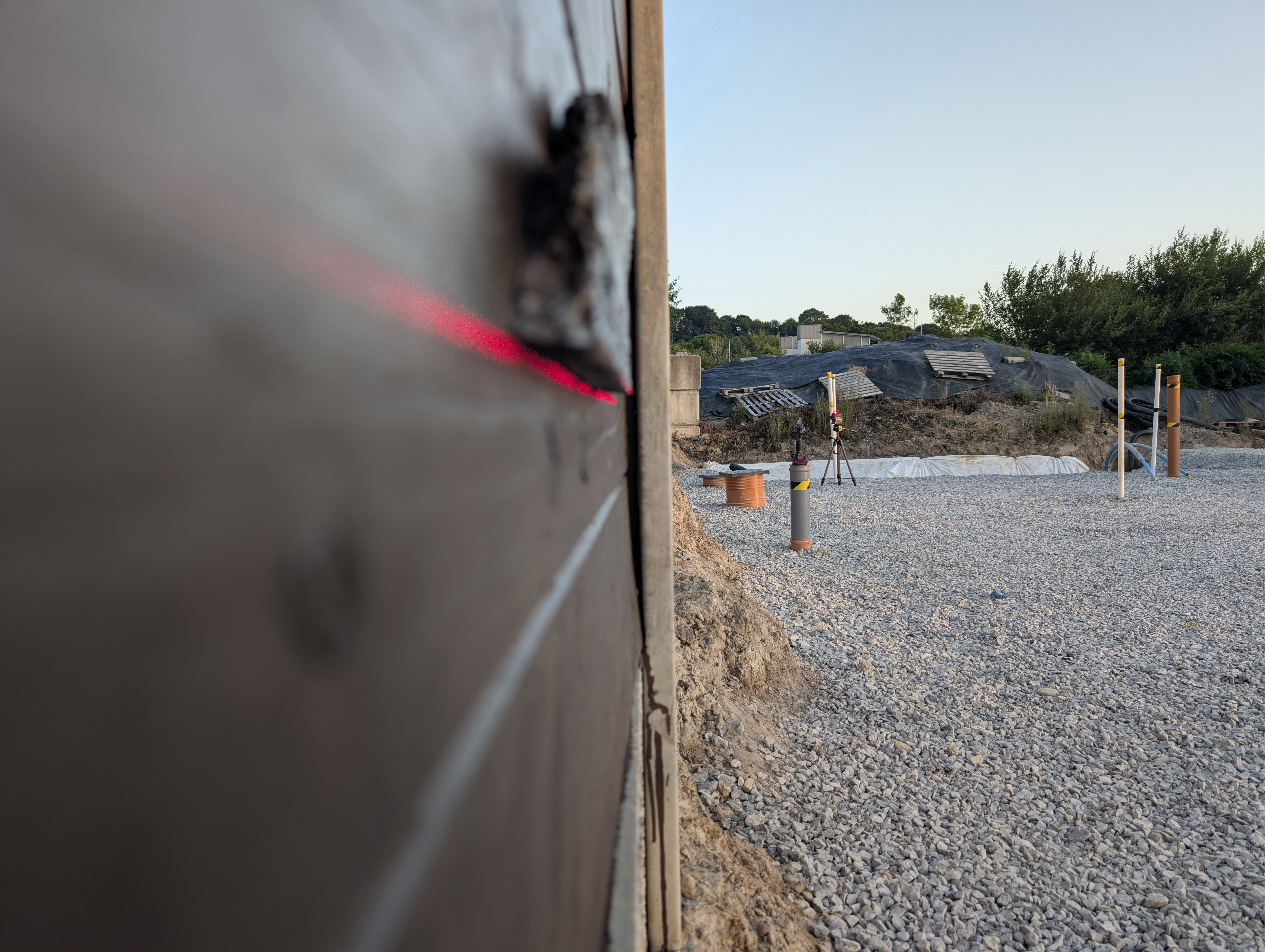
Many years ago now, I had screwed three pieces of wood to the wooden fence to mark 75.08 over sea level, and all works since have used that as the reference level. Unfortunately, one bit of wood split and so had to be removed, and another got put out of alignment due to the wood staining. That left me with just one reference level marker, which got me anxious due to the lack of redundancy, so before the professional surveyor arrived I remounted two additional reference levels matching the one remaining one.
As my laser level is an indoor only model, I had to wait to dusk to be able to see the laser:
I remember being very, very tired when doing this work as I had been up at 4am and having to stay up until dusk really sucked. But I knew I’d get a lie in the following day, and I think I ended up asleep that following day until about 1pm as I had built up such a sleep debt.
When the surveyor came, we found that the bottom of those reference markers is more like 75.07 rather than 75.08. Thankfully, it didn’t seem to affect the stone levels according to the same survey, they were all spot on or slightly lower. I was also rather glad to learn that my marker on the wall other side of the site was just 4 mm off: my laser level, a Bosch prosumer model, promised <= 0.02% height error per metre of distance – over 35 metres, you would expect the error to therefore be less than 7 mm, so it was well within claimed specifications and only 43% worse than a commercial laser level.
The as-built survey
My surveyor, knowing that I have been more than a year without income, very kindly offered to reduce his bill if I did the post-processing work of taking his raw data and adjusting it to calculate the locations of all the popups. To explain, the problem with a pipe sticking up is you can’t directly measure the X-Y location of its centre, rather you can measure its side and then you need to offset that X-Y location in to the centre of the popup by half its diameter plus 15 mm (which is half the width of the X-Y location measuring stick). My surveyor would normally do that work and charge me for his time, but he reckoned me technically able enough to do it myself. And I am most grateful to him for that, every euro saved counts right now. Here is my as-built image of the site overlaid on the most recent drone photo taken a few days ago:
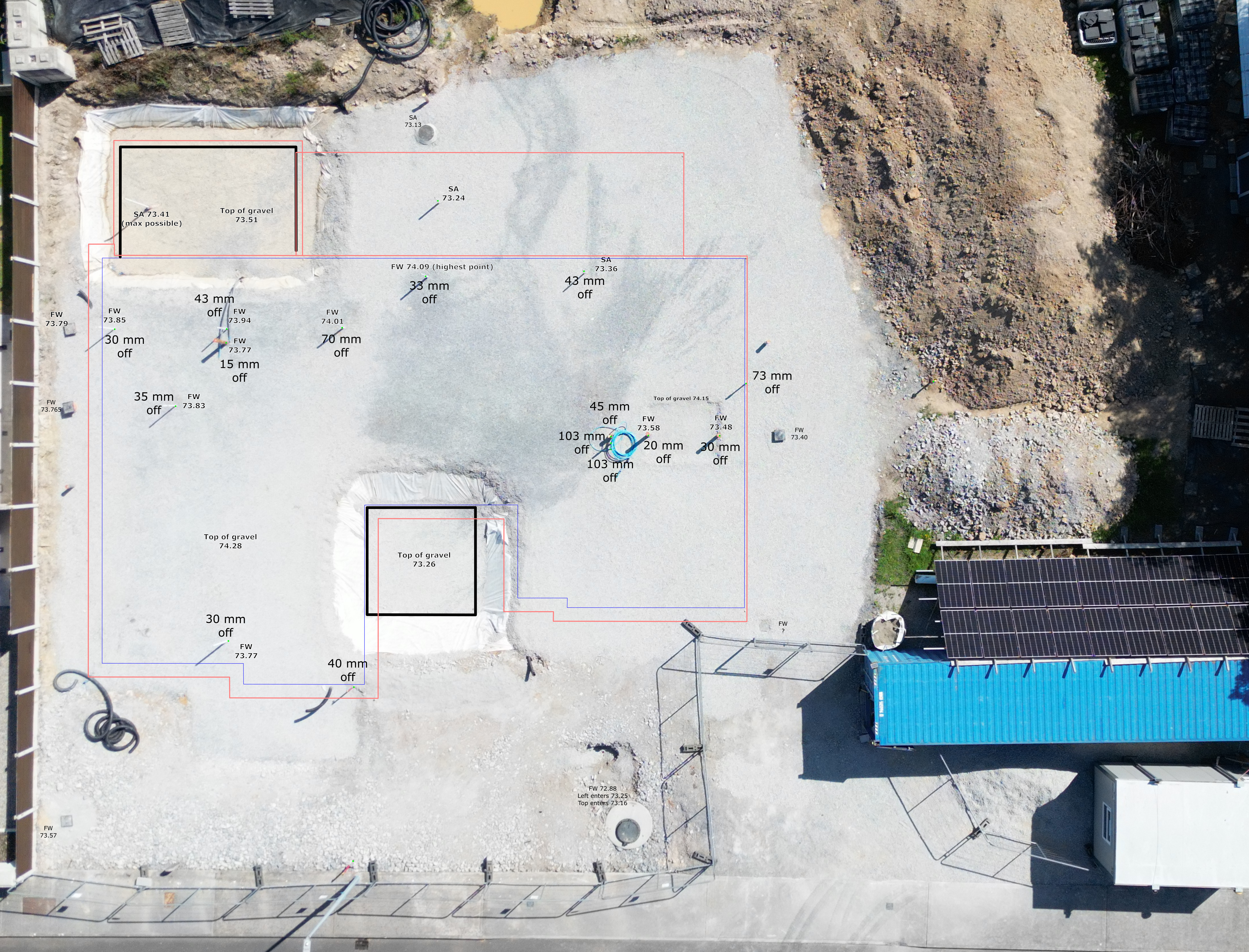
The levels shown above for the pool cavity, tree cavity and steel pad cavity are all as built; each popup as built is shown as a small green dot with its deviation from plans in text next to it; and the foulwater (FW) and stormwater (SA) all show the bottom of each pipe or inspection chamber as built. As with the sewer levels being somewhat off in places by up to 80 mm, so were the X-Y popup locations where the deviation was between 20 and 70 mm apart from the ESB ducts which are 100 mm off. Those ESB ducts being so far off is annoying, but as they are ESB ducts you can give them repeated kicks to get them back into position without disturbing the falls below in ways which matter (i.e. you can’t kick sewer pipes into position, you might create a trap) and/or you can bend them back into position as they go through the concrete slab.
So I think we’re all good, the only place where an out of place popup will matter is the one for the washing machine where it now pops up within the wall. We’ll have to perforate the wall, but as it’ll be behind the washing machine and you can’t see it I don’t think I care.
What’s next?
Here is the site right now. It’s only taken more than five years and €440,000 of my money to reach this:
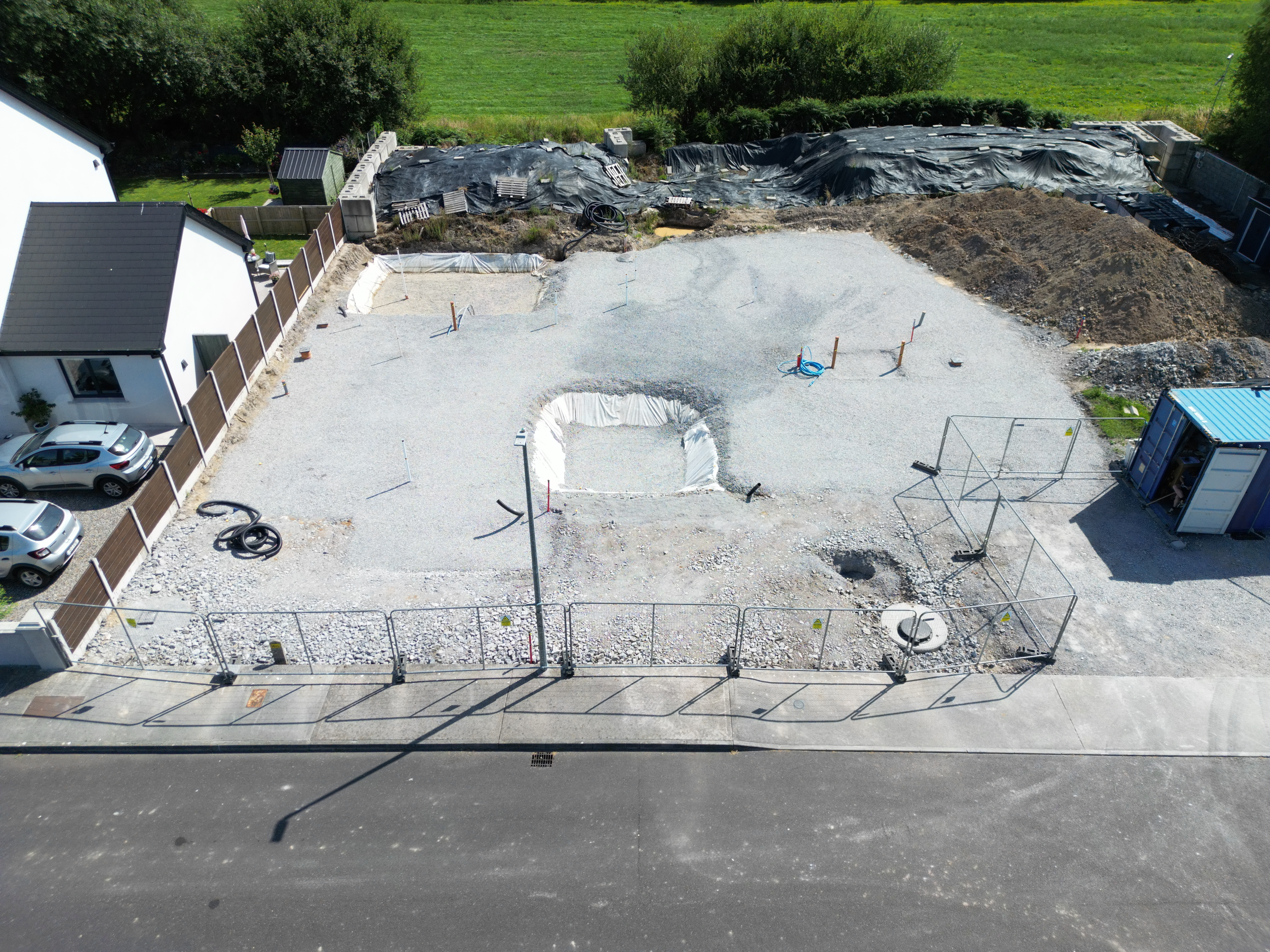
Utter madness really. If I could go back to when I started this knowing what I know now, I would not have started building this house. It isn’t worth the years of time nor the hundreds of thousands of money I could have spent elsewhere.
Still, we are committed now, walking away would consign to the dustbin most of the money spent, so we can only go forwards.
Unfortunately, the remainder of the summer won’t be much fun for anybody:
- Next week the kids will most likely be painting the rightmost concrete block wall white. I’ll give them break days in between to decompress, but I expect it’ll take the week to complete.
- The week after that, the first week of August, has a bank holiday and I might take them somewhere nice. Megan has been studying all day long every day these past two weeks and shall be for the next two weeks, so I just need to take the kids away elsewhere. We do also have some furniture to upcycle, it just needs to be sanded and painted, it shouldn’t take long and most of the structural reworking has already been done.
- The second week of August is Megan’s final chartered accountancy exams week, that will surely be a stressful week for all.
- The third week of August is a WG14 C standards meeting, at which I’ll be presenting three of my papers. I’m sure Megan will take the kids to fun places as she’ll likely want to go have some fun herself after all these years of study.
- The fourth week of August I believe the kids return to school at the end of it, so the summer will be over for them.
You can see in the photo above that the soil spill pile hasn’t been removed! We’re waiting in Green Valley’s queue to have that removed. As with the groundworks, we won’t know when they’re going to remove it until the day before, so until then we’ll be unable to book anything much in advance lest it get wasted. So I expect e-bike rides, maybe day trips to things nearby which don’t cost much e.g. beaches, West Cork, that sort of thing.
What will come after August? That’s a very good question. I have taxes to sort out, we’re in a novel situation I haven’t dealt with before with those, so they’ll need to be figured out and that’ll likely take a few weeks and a few grand of fees to advisors. We are currently likely to run very low on cash some time this Autumn according to current projections, so I’ll need to do something to get ahead of that before it becomes critical.
Much I guess depends on when this AI investment bubble bursts. I was reading this week that at least 1.6 trillion dollars of AI datacentre building debt has been accumulated into off balance sheet Special Purpose Vehicles (SPVs), which is the same mechanism Enron used to blow itself up in the early 2000s. Apparently about half the borrowing comes from pension funds, a quarter from wealthy individuals, and the remainder is circularity of cross investment by SPV owners and government subsidies. When the party stops – and it will – contagion will set off a chain reaction of SPV collapse and at least one tech multinational will likely see a run on its stock, which means it’ll need to be bailed out by the taxpayer or bought at firesale prices by a competitor. So just like the bank bailouts and collapses of the 2009 financial collapse, but this time with tech multinationals. This fun game of musical chairs guarantees some will cease to exist, and the theory is that that whoever remains will thereafter profit handsomely.
I’m not personally sure that’s the case at all as I think those who build out the infrastructure won’t have the moat to reap more than a tiny slice of the profits from it – we saw something very similar with the telecommunications bubble up to the 2001 tech bubble collapse where most of the benefits and value accrued to those who used the telecommunications infrastructure, and very little to those who had built it out. If true, places like Europe which have mostly ignored the building out part of AI will benefit handsomely having skipped paying for its development, and getting to deploy upon it with all gusto as their powder will be still dry. Maybe there’s a diary entry in there explaining my thoughts on that, maybe I’ll write that in the Autumn if I run out of other things to do. We’ll see.
If time presents, I really do need to get back onto open source library development as I need to refresh my portfolio so I look more employable after the AI investment bubble bursts. It would do no harm for me to present at a few conferences either – I did submit to ACCU this year, but my talk was rejected. I’ll try again for 2027. Hopefully, though, I’ll have a house on my site soon and I can go work in that each and every day until we can move into it.
| Go to previous entry | Go to next entry | Go back to the archive index | Go back to the latest entries |